Published by
Published on
February 26, 2026
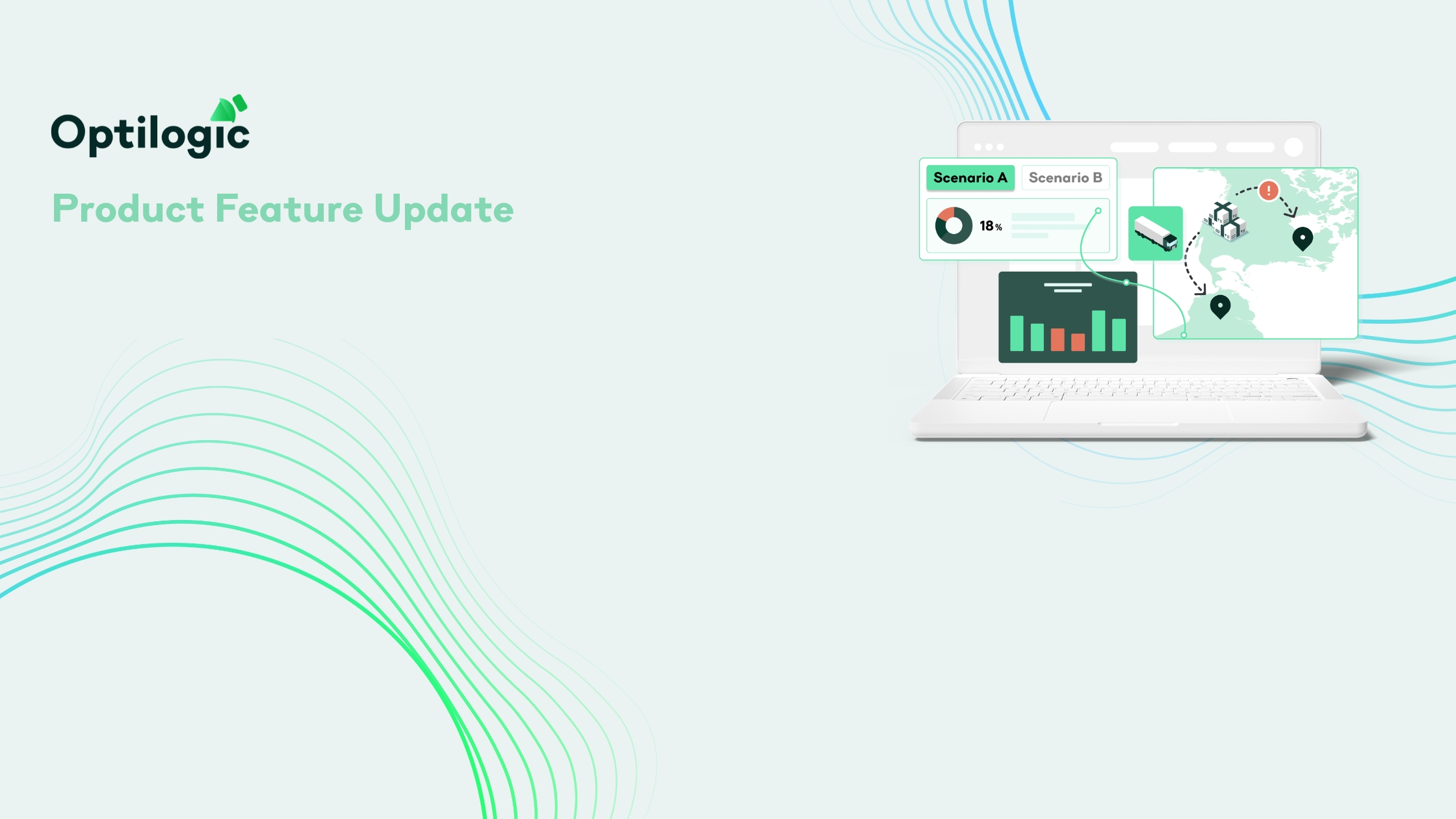



This month's releases reflect two distinct but equally important dimensions of Optilogic's AI-first platform: AI capabilities that eliminate the time-consuming tedious work standing between modelers and meaningful analysis, and a landmark advancement in optimization that brings network design and transportation routing together in a single solve for the first time.
Before a single scenario can run, someone has to wrangle the data. Clean it. Fill in the gaps. Build out cost assumptions. Define territory structures. This prep work doesn't show up in a model's output — but it stands between modeling teams and what AI-driven supply chain design promises to deliver: intelligence and speed.
The latest releases represent another significant step in Optilogic's agentic AI innovation, focused squarely on eliminating that hidden tax. Three new capabilities work in sequence:
This is what sets Optilogic apart — a composable, AI-first platform built for supply chain. These three capabilities compress what has historically been days or weeks of setup into a workflow that gets modelers to the work that actually matters: faster analysis, more scenarios, and better decisions.
Before any supply chain model can run, data must be prepped. And getting data right has always been the unglamorous work that consumes days before real analysis can begin.
The new Data Cleansing Agent in DataStar changes that. Describe your data problem in natural language, and the agent profiles your data, builds a plan, applies the fixes, and verifies the results — all on a safe copy, so your original data is never touched.
The agent handles the full range of common supply chain data quality problems, including:
Every transformation is logged step by step, giving you a complete audit trail of exactly what changed and why. The agent adapts to your prompt, discovers the schema automatically, and can run multiple cleanup tasks in parallel for faster results.
What previously meant writing SQL queries column by column now takes a single prompt and a few minutes. The data cleansing agent is available now in DataStar via the Run Utility task. Visit the Resource Library for help getting started and to locate a template model.
Transportation costs are the backbone of any credible supply chain model. But sourcing accurate rates for every lane — especially new or infrequently used ones — has always been a bottleneck. Teams end up relying on rough estimates or leaving lanes blank, producing models that leadership can't trust.
The FTL and LTL Costing Agents in DataStar eliminate that problem, using your historical shipment data and proven benchmark rates to ensure every lane has a cost you can stand behind.
For Full Truckload (FTL): the agent works through a layered matching pipeline — starting with exact lane matches and progressively broadening to ZIP-3, state, and regional benchmarks when history isn't available. Every output includes a confidence level so you always know how solid each estimate is.
For Less-Than-Truckload (LTL): rate lookups are automated based on service level, distance, and shipment weight, with built-in carrier rate tables — no additional rate data to source or maintain.
Both agents run directly in DataStar: upload your lanes, configure the parameters, and receive a fully costed output table — no code, no manual lookups, no guesswork.
What previously required weeks of manual research now takes minutes, with full transparency into how each rate was derived — enabling faster time-to-insight and more confident conversations with leadership. Visit the resource library to get started with FTL and LTL.
Ask any routing tool to minimize costs and it will give you an answer — but that answer often produces routes that save money on paper but cost you in practice.
Territory Planning in Cosmic Frog brings cost efficiency and operational structure together. It automatically clusters customers into geographically coherent delivery zones and ensures routes and drivers stay within defined boundaries.
Simply specify the number of territories and your capacity constraints. The optimizer evaluates thousands of configurations and surfaces the best arrangement, along with two new output tables:
Run an unconstrained optimization alongside your territory design to see exactly what operational structure costs — you see the trade-offs, you make the call.
"Territory Planning lets us design territories that deliver the highest service levels to our customers while minimizing routing costs. It's changed how we think about delivery as a competitive advantage." — Leading retailer
Territory Planning is available now in Cosmic Frog, with a Help Center article and a template model in the Resource Library to get you started. Read the full announcement to learn more.
Earlier this month, we announced Network Transportation Optimization — a landmark capability in Cosmic Frog that integrates strategic network design with multi-stop routing in a single solve, uncovering savings and ensuring operationally executable decisions that traditional point-to-point models miss.
All features are available now in the Optilogic platform. Have questions? Reach out to your Customer Success Manager or visit support@optilogic.com for documentation and tutorials.
This month's releases reflect two distinct but equally important dimensions of Optilogic's AI-first platform: AI capabilities that eliminate the time-consuming tedious work standing between modelers and meaningful analysis, and a landmark advancement in optimization that brings network design and transportation routing together in a single solve for the first time.
Before a single scenario can run, someone has to wrangle the data. Clean it. Fill in the gaps. Build out cost assumptions. Define territory structures. This prep work doesn't show up in a model's output — but it stands between modeling teams and what AI-driven supply chain design promises to deliver: intelligence and speed.
The latest releases represent another significant step in Optilogic's agentic AI innovation, focused squarely on eliminating that hidden tax. Three new capabilities work in sequence:
This is what sets Optilogic apart — a composable, AI-first platform built for supply chain. These three capabilities compress what has historically been days or weeks of setup into a workflow that gets modelers to the work that actually matters: faster analysis, more scenarios, and better decisions.
Before any supply chain model can run, data must be prepped. And getting data right has always been the unglamorous work that consumes days before real analysis can begin.
The new Data Cleansing Agent in DataStar changes that. Describe your data problem in natural language, and the agent profiles your data, builds a plan, applies the fixes, and verifies the results — all on a safe copy, so your original data is never touched.
The agent handles the full range of common supply chain data quality problems, including:
Every transformation is logged step by step, giving you a complete audit trail of exactly what changed and why. The agent adapts to your prompt, discovers the schema automatically, and can run multiple cleanup tasks in parallel for faster results.
What previously meant writing SQL queries column by column now takes a single prompt and a few minutes. The data cleansing agent is available now in DataStar via the Run Utility task. Visit the Resource Library for help getting started and to locate a template model.
Transportation costs are the backbone of any credible supply chain model. But sourcing accurate rates for every lane — especially new or infrequently used ones — has always been a bottleneck. Teams end up relying on rough estimates or leaving lanes blank, producing models that leadership can't trust.
The FTL and LTL Costing Agents in DataStar eliminate that problem, using your historical shipment data and proven benchmark rates to ensure every lane has a cost you can stand behind.
For Full Truckload (FTL): the agent works through a layered matching pipeline — starting with exact lane matches and progressively broadening to ZIP-3, state, and regional benchmarks when history isn't available. Every output includes a confidence level so you always know how solid each estimate is.
For Less-Than-Truckload (LTL): rate lookups are automated based on service level, distance, and shipment weight, with built-in carrier rate tables — no additional rate data to source or maintain.
Both agents run directly in DataStar: upload your lanes, configure the parameters, and receive a fully costed output table — no code, no manual lookups, no guesswork.
What previously required weeks of manual research now takes minutes, with full transparency into how each rate was derived — enabling faster time-to-insight and more confident conversations with leadership. Visit the resource library to get started with FTL and LTL.
Ask any routing tool to minimize costs and it will give you an answer — but that answer often produces routes that save money on paper but cost you in practice.
Territory Planning in Cosmic Frog brings cost efficiency and operational structure together. It automatically clusters customers into geographically coherent delivery zones and ensures routes and drivers stay within defined boundaries.
Simply specify the number of territories and your capacity constraints. The optimizer evaluates thousands of configurations and surfaces the best arrangement, along with two new output tables:
Run an unconstrained optimization alongside your territory design to see exactly what operational structure costs — you see the trade-offs, you make the call.
"Territory Planning lets us design territories that deliver the highest service levels to our customers while minimizing routing costs. It's changed how we think about delivery as a competitive advantage." — Leading retailer
Territory Planning is available now in Cosmic Frog, with a Help Center article and a template model in the Resource Library to get you started. Read the full announcement to learn more.
Earlier this month, we announced Network Transportation Optimization — a landmark capability in Cosmic Frog that integrates strategic network design with multi-stop routing in a single solve, uncovering savings and ensuring operationally executable decisions that traditional point-to-point models miss.
All features are available now in the Optilogic platform. Have questions? Reach out to your Customer Success Manager or visit support@optilogic.com for documentation and tutorials.
Fill out the form to unlock the full content
.jpg)