Published by
Published on
March 10, 2026



Fill out the form to unlock the full content
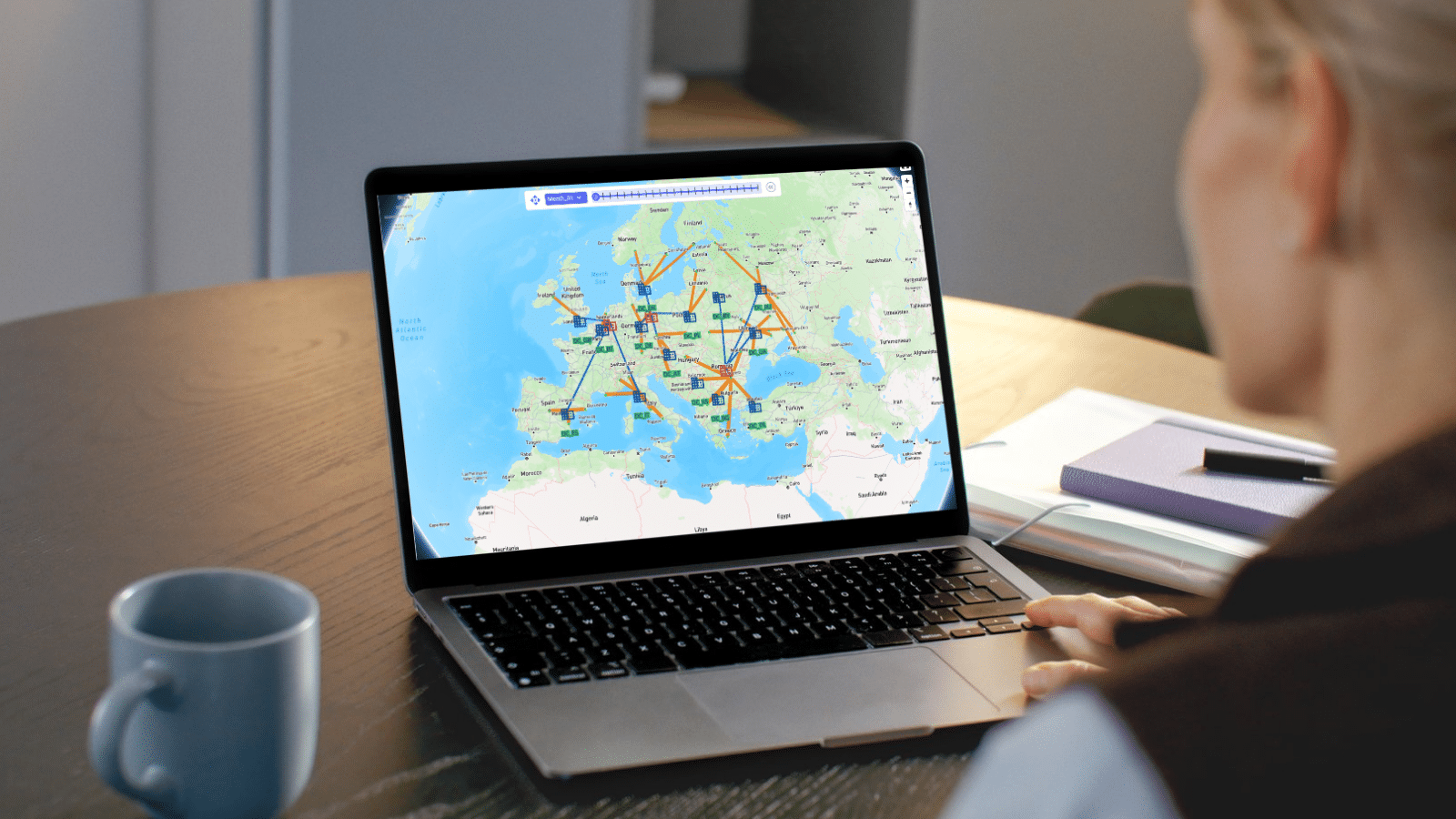
Cosmic Frog is Optilogic's AI-first supply chain design platform. It lets organizations model, optimize, and simulate their supply chains — and evaluate trade-offs across cost, service, risk, and sustainability — before committing real money to real-world changes.
There's a meaningful difference between managing the supply chain you already have and redesigning the one you need. Network structure, sourcing strategy, inventory positioning — these are the decisions where competitive advantage is won or lost. Cosmic Frog is built to get you there faster. It's trusted by organizations ranging from mid-size manufacturers to global enterprises like Coca-Cola and General Motors.
Cosmic Frog is built for high-stakes questions without obvious answers — and tactical ones where getting it wrong is expensive. The platform spans strategic network design, sourcing, inventory positioning, transportation optimization, and risk modeling, all within a single model. Questions it helps answer include:
No. Cosmic Frog runs entirely in your browser — no installation, no IT footprint, no version management. Log in from any modern browser on Windows, macOS, or Linux and start modeling. Updates roll out automatically in the background, so you always have the latest features without doing anything.
Yes. Create a free account to access the platform with no credit card required. When you create a new model, you can choose from pre-populated sample models that already include data, scenarios, maps, and dashboards — so you can start exploring immediately without building anything from scratch. You can also access training courses, review "Getting Started" articles in the Help Center, find demo models in the resource library, and the Frogger Pond community to accelerate your learning.
No. When you create a new model, choose from pre-populated sample or template models — each already includes data, scenarios, maps, and dashboards so you can start testing ideas in minutes. Or skip the template entirely: describe what you want to model in natural language and agentic AI builds the structure for you, no manual configuration required.
Faster than you probably expect. With clean data and a defined question, an experienced modeler can have a working baseline in days. DataStar's AI-automated data prep eliminates the manual wrangling that historically consumed the most setup time — connecting to your data sources, profiling and cleansing, and getting to decision-ready inputs without the usual back-and-forth.
For teams new to supply chain design, Optilogic's agentic AI can build model structure from a plain-language description of what you're solving, so you're not starting from a blank schema. Most customers are running meaningful scenarios within their first few weeks.
Optilogic's AI eliminates model building. Describe what you're trying to solve in plain language, and AI generates the full model structure for you — removing the single biggest barrier to getting value from supply chain optimization. What used to take weeks of manual setup can now happen in hours.
Beyond model building, purpose-built agentic AI automates other high-effort steps across the modeling workflow, including natural language interaction for pulling demand data, generating scenarios, and comparing design alternatives. And through Composable Apps, AI agents handle data ingestion, app creation, and deployment — getting answers into the hands of your teams in days, not months.
Gartner predicts that by 2030, 50% of cross-functional supply chain management solutions will use intelligent agents to execute decisions. Cosmic Frog is already there.
Optilogic Composable Apps let you build and deploy decision-making applications directly from your supply chain data — without implementing a massive new system. AI agents handle data ingestion, app creation, and deployment, so your teams can go from raw data to a working app in as little as 2–3 days.
Cosmic Frog serves as the optimization engine underneath: your network design models, scenarios, and outputs become the foundation for apps you can deploy across your organization. Instead of replacing your existing planning systems, Composable Apps fill the gaps — giving your teams fast access to answers that your current tools don't provide.
Yes, interchangeably. Your model lives in File Explorer. Right-click it, choose "Open in Atlas," and you're in Cosmic Frog's built-in Python workspace. Switch back to the visual interface at any time — the model stays in sync. Atlas supports Gurobi, CPLEX, HiGHS, GLPK, and other solvers, and lets your technical team write custom constraints, objectives, and workflows directly against your model data.
Optilogic's AI eliminates model building. Describe what you're trying to solve in plain language and AI generates the full model structure for you — what used to take weeks of manual setup now happens in hours.
Once you're solving, Cosmic Frog is 100% cloud-native — every scenario runs on cloud infrastructure, not on a local machine or hybrid desktop system. With a desktop tool, you submit one scenario, wait overnight, find out it hit an issue, and run it again the next night. With Cosmic Frog, you can run 20 scenarios simultaneously by lunch.
There's also a fidelity advantage. Competing tools require you to aggregate your data — grouping SKUs, customers, or suppliers — to make the model solvable. That aggregation introduces inaccuracy. Cosmic Frog handles SKU-level detail at full scale, so your model reflects your actual supply chain, not a simplified approximation of it. More scenarios at higher accuracy means you're more likely to find the non-obvious answer: the network configuration that saves $8M annually, the sourcing shift that reduces disruption exposure by 23%, the DC location your team wouldn't have considered.
GM used Cosmic Frog to build the most detailed digital supply chain model in the company's history — a fully disaggregated model spanning 3 million vehicles and 300 million parts annually, across 3,400 suppliers and 22,000 customers. The core model included 260,000+ SKUs and 29 million sourcing policies, solved using Optilogic's Supernova cloud technology with 2TB of RAM compute power, processing 26 million demand records.
GM's prior tools required data aggregation that limited fidelity. With Cosmic Frog, they modeled at full granularity — SKU-level precision across the entire network — for the first time.
"We can now build models to match the challenge — not the other way around." — Mike Stafiej, Manager of Network Intelligence & Design, GM
Yes — and complex is where Cosmic Frog is most differentiated. The platform supports multi-echelon networks from a single warehouse to global multi-tier footprints, with modeling at SKU, order, and shipment level of detail. You can define custom constraints around flow, capacity, service levels, and cost structures. Multi-objective optimization lets you trade off cost, service, risk, and sustainability simultaneously — not just minimize cost.
Because Cosmic Frog is cloud-native, it scales elastically: models with tens of millions of rows and hundreds of thousands of SKUs are routine. And if your business rules go beyond standard configurations, Atlas gives your technical team a Python environment to build exactly what you need.
DataStar is Optilogic's data preparation platform — where raw supply chain data gets cleaned, transformed, and made model-ready before entering Cosmic Frog. It pulls from your ERP, TMS, WMS, or other systems, applies AI-automated cleansing and workflow logic, and outputs a structured dataset that feeds directly into your model. Optilogic's agentic AI works within DataStar too, letting you create transformation tasks in natural language without writing code.
After a model run, DataStar helps analyze outputs — generating reports, surfacing savings opportunities, and comparing scenarios against a baseline. Instead of spending weeks stitching together data, you move from raw inputs to running scenarios in a fraction of the time.
Yes. Several options are available:
Yes. Cosmic Frog includes an integrated geocoding API — no separate subscription required. For distance calculations, it supports Bing, Google, PTV, and PC*MILER. If you already use one of these services, connect your existing account directly to Cosmic Frog.
Optimization finds the best answer given your assumptions. Simulation stress-tests that answer in a realistic, probabilistic environment — demand fluctuations, lead time uncertainty, supplier disruptions, and more. Cosmic Frog's discrete-event simulation engine uses the same data schema as the optimizer, so you're not rebuilding anything to switch modes. Run your optimized design through simulation to validate service rates, identify failure points, and build confidence before you make changes in the real world.
Yes — supply chain design is exactly the right tool for this. When conditions change — tariff exposure, a supplier going dark, shifting demand geography — you can't plan your way out of a bad structure. Cosmic Frog lets you redesign fast: model the disruption, run scenarios, and identify the structural response that balances cost, service, and risk. Optilogic's Lumina Tariff Optimizer is purpose-built for tariff-specific scenarios if that's your immediate priority.
Optimization tells you the theoretically optimal answer. Incremental design tells you how to actually get there. For example: a model recommends consolidating 12 DCs to 7, shifting 40% of sourcing volume, and changing suppliers for 200 SKUs — but the operations team can realistically execute two of those things this year. Incremental design accounts for that. You set real-world constraints on change — no more than two or three facility decisions per phase, minimum service floors, capital budget limits — and the model produces a phased, executable roadmap. Most design solutions stop at the optimal answer. Cosmic Frog helps you build the business case for each phase and execute it.
Cosmic Frog was built cloud-native from the ground up — not retrofitted from a desktop tool. That matters in three specific ways.
Yes. Cosmic Frog includes a model converter. Upload your model file and it will be converted into a Cosmic Frog model and appear in your workspace. You're not starting from scratch when you switch.
Ready to see how fast you can start answering your own supply chain questions? Create a free Optilogic account to explore our Design Intelligence Platform firsthand—build models, run scenarios, and collaborate with your team in minutes.
Try it for free
Cosmic Frog is Optilogic's AI-first supply chain design platform. It lets organizations model, optimize, and simulate their supply chains — and evaluate trade-offs across cost, service, risk, and sustainability — before committing real money to real-world changes.
There's a meaningful difference between managing the supply chain you already have and redesigning the one you need. Network structure, sourcing strategy, inventory positioning — these are the decisions where competitive advantage is won or lost. Cosmic Frog is built to get you there faster. It's trusted by organizations ranging from mid-size manufacturers to global enterprises like Coca-Cola and General Motors.
Cosmic Frog is built for high-stakes questions without obvious answers — and tactical ones where getting it wrong is expensive. The platform spans strategic network design, sourcing, inventory positioning, transportation optimization, and risk modeling, all within a single model. Questions it helps answer include:
No. Cosmic Frog runs entirely in your browser — no installation, no IT footprint, no version management. Log in from any modern browser on Windows, macOS, or Linux and start modeling. Updates roll out automatically in the background, so you always have the latest features without doing anything.
Yes. Create a free account to access the platform with no credit card required. When you create a new model, you can choose from pre-populated sample models that already include data, scenarios, maps, and dashboards — so you can start exploring immediately without building anything from scratch. You can also access training courses, review "Getting Started" articles in the Help Center, find demo models in the resource library, and the Frogger Pond community to accelerate your learning.
No. When you create a new model, choose from pre-populated sample or template models — each already includes data, scenarios, maps, and dashboards so you can start testing ideas in minutes. Or skip the template entirely: describe what you want to model in natural language and agentic AI builds the structure for you, no manual configuration required.
Faster than you probably expect. With clean data and a defined question, an experienced modeler can have a working baseline in days. DataStar's AI-automated data prep eliminates the manual wrangling that historically consumed the most setup time — connecting to your data sources, profiling and cleansing, and getting to decision-ready inputs without the usual back-and-forth.
For teams new to supply chain design, Optilogic's agentic AI can build model structure from a plain-language description of what you're solving, so you're not starting from a blank schema. Most customers are running meaningful scenarios within their first few weeks.
Optilogic's AI eliminates model building. Describe what you're trying to solve in plain language, and AI generates the full model structure for you — removing the single biggest barrier to getting value from supply chain optimization. What used to take weeks of manual setup can now happen in hours.
Beyond model building, purpose-built agentic AI automates other high-effort steps across the modeling workflow, including natural language interaction for pulling demand data, generating scenarios, and comparing design alternatives. And through Composable Apps, AI agents handle data ingestion, app creation, and deployment — getting answers into the hands of your teams in days, not months.
Gartner predicts that by 2030, 50% of cross-functional supply chain management solutions will use intelligent agents to execute decisions. Cosmic Frog is already there.
Optilogic Composable Apps let you build and deploy decision-making applications directly from your supply chain data — without implementing a massive new system. AI agents handle data ingestion, app creation, and deployment, so your teams can go from raw data to a working app in as little as 2–3 days.
Cosmic Frog serves as the optimization engine underneath: your network design models, scenarios, and outputs become the foundation for apps you can deploy across your organization. Instead of replacing your existing planning systems, Composable Apps fill the gaps — giving your teams fast access to answers that your current tools don't provide.
Yes, interchangeably. Your model lives in File Explorer. Right-click it, choose "Open in Atlas," and you're in Cosmic Frog's built-in Python workspace. Switch back to the visual interface at any time — the model stays in sync. Atlas supports Gurobi, CPLEX, HiGHS, GLPK, and other solvers, and lets your technical team write custom constraints, objectives, and workflows directly against your model data.
Optilogic's AI eliminates model building. Describe what you're trying to solve in plain language and AI generates the full model structure for you — what used to take weeks of manual setup now happens in hours.
Once you're solving, Cosmic Frog is 100% cloud-native — every scenario runs on cloud infrastructure, not on a local machine or hybrid desktop system. With a desktop tool, you submit one scenario, wait overnight, find out it hit an issue, and run it again the next night. With Cosmic Frog, you can run 20 scenarios simultaneously by lunch.
There's also a fidelity advantage. Competing tools require you to aggregate your data — grouping SKUs, customers, or suppliers — to make the model solvable. That aggregation introduces inaccuracy. Cosmic Frog handles SKU-level detail at full scale, so your model reflects your actual supply chain, not a simplified approximation of it. More scenarios at higher accuracy means you're more likely to find the non-obvious answer: the network configuration that saves $8M annually, the sourcing shift that reduces disruption exposure by 23%, the DC location your team wouldn't have considered.
GM used Cosmic Frog to build the most detailed digital supply chain model in the company's history — a fully disaggregated model spanning 3 million vehicles and 300 million parts annually, across 3,400 suppliers and 22,000 customers. The core model included 260,000+ SKUs and 29 million sourcing policies, solved using Optilogic's Supernova cloud technology with 2TB of RAM compute power, processing 26 million demand records.
GM's prior tools required data aggregation that limited fidelity. With Cosmic Frog, they modeled at full granularity — SKU-level precision across the entire network — for the first time.
"We can now build models to match the challenge — not the other way around." — Mike Stafiej, Manager of Network Intelligence & Design, GM
Yes — and complex is where Cosmic Frog is most differentiated. The platform supports multi-echelon networks from a single warehouse to global multi-tier footprints, with modeling at SKU, order, and shipment level of detail. You can define custom constraints around flow, capacity, service levels, and cost structures. Multi-objective optimization lets you trade off cost, service, risk, and sustainability simultaneously — not just minimize cost.
Because Cosmic Frog is cloud-native, it scales elastically: models with tens of millions of rows and hundreds of thousands of SKUs are routine. And if your business rules go beyond standard configurations, Atlas gives your technical team a Python environment to build exactly what you need.
DataStar is Optilogic's data preparation platform — where raw supply chain data gets cleaned, transformed, and made model-ready before entering Cosmic Frog. It pulls from your ERP, TMS, WMS, or other systems, applies AI-automated cleansing and workflow logic, and outputs a structured dataset that feeds directly into your model. Optilogic's agentic AI works within DataStar too, letting you create transformation tasks in natural language without writing code.
After a model run, DataStar helps analyze outputs — generating reports, surfacing savings opportunities, and comparing scenarios against a baseline. Instead of spending weeks stitching together data, you move from raw inputs to running scenarios in a fraction of the time.
Yes. Several options are available:
Yes. Cosmic Frog includes an integrated geocoding API — no separate subscription required. For distance calculations, it supports Bing, Google, PTV, and PC*MILER. If you already use one of these services, connect your existing account directly to Cosmic Frog.
Optimization finds the best answer given your assumptions. Simulation stress-tests that answer in a realistic, probabilistic environment — demand fluctuations, lead time uncertainty, supplier disruptions, and more. Cosmic Frog's discrete-event simulation engine uses the same data schema as the optimizer, so you're not rebuilding anything to switch modes. Run your optimized design through simulation to validate service rates, identify failure points, and build confidence before you make changes in the real world.
Yes — supply chain design is exactly the right tool for this. When conditions change — tariff exposure, a supplier going dark, shifting demand geography — you can't plan your way out of a bad structure. Cosmic Frog lets you redesign fast: model the disruption, run scenarios, and identify the structural response that balances cost, service, and risk. Optilogic's Lumina Tariff Optimizer is purpose-built for tariff-specific scenarios if that's your immediate priority.
Optimization tells you the theoretically optimal answer. Incremental design tells you how to actually get there. For example: a model recommends consolidating 12 DCs to 7, shifting 40% of sourcing volume, and changing suppliers for 200 SKUs — but the operations team can realistically execute two of those things this year. Incremental design accounts for that. You set real-world constraints on change — no more than two or three facility decisions per phase, minimum service floors, capital budget limits — and the model produces a phased, executable roadmap. Most design solutions stop at the optimal answer. Cosmic Frog helps you build the business case for each phase and execute it.
Cosmic Frog was built cloud-native from the ground up — not retrofitted from a desktop tool. That matters in three specific ways.
Yes. Cosmic Frog includes a model converter. Upload your model file and it will be converted into a Cosmic Frog model and appear in your workspace. You're not starting from scratch when you switch.
Ready to see how fast you can start answering your own supply chain questions? Create a free Optilogic account to explore our Design Intelligence Platform firsthand—build models, run scenarios, and collaborate with your team in minutes.
Try it for freeReady to see how fast you can start answering your own supply chain questions? Create a free Optilogic account to explore our Design Intelligence Platform firsthand—build models, run scenarios, and collaborate with your team in minutes.
.jpg)