Published by
Vikram Srinivasan
Published on
May 14, 2026




By Vikram Srinivasan, VP of Solution Architecture and New Products, Optilogic
Supply chain teams lose millions of dollars a year to stockouts, excess inventory, and expediting costs that trace back to a critical factor: demand signals that aren't granular enough to drive the decisions that depend on them.
A monthly forecast at the product family level can look perfectly accurate while simultaneously failing every planner, analyst, and logistics manager who needs SKU-location-level inputs to do their job.
That's the difference between demand forecasting (predicting future volumes for planning purposes) and demand modeling, which goes further — incorporating internal and external drivers of demand to build a holistic view, then translating that into the precise inputs supply chain decisions actually require.
Most companies have the first. Far fewer have the second. And the difference shows up directly in inventory positioning, capacity decisions, routing efficiency, and service levels.
The symptoms are recognizable:
These aren't operations problems. They're demand signal problems — and they're solvable.
Demand forecasting and demand modeling are not the same thing — and treating them as interchangeable is one of the most common and costly mistakes in supply chain planning.
Demand forecasting is about predicting future volumes. It feeds a demand planning process: statistical baseline, consensus from sales and finance, roll-up to a number that drives the next quarter. It's essential, but it's a starting point.
Demand modeling goes deeper. It's about understanding why demand behaves the way it does — seasonality, promotional lift, causal drivers, correlations across products and locations. And critically, it's about translating that understanding into the granularity that actual supply chain decisions require.
"You're not replacing your current company's forecasting process. You're actually leveraging it. You're just adding more information and insights to it and translating it to the right level of granularity for your decision." -Vikram Srinivasan, VP of Solution Architecture and New Products, Optilogic
That's the difference.
Here's the core problem. Most forecasting processes operate at a level of aggregation that's appropriate for demand planning — but not for supply chain design.
You get a top-line forecast. Your teams spread that number down to individual SKUs, locations, and customers using simple allocation rules. What practitioners call "peanut butter spreading" — every location gets roughly the same percentage of the total.
But every customer-SKU combination has its own unique demand pattern. When you wash all of that out into an equal allocation, you're making decisions based on a signal that doesn't reflect reality.
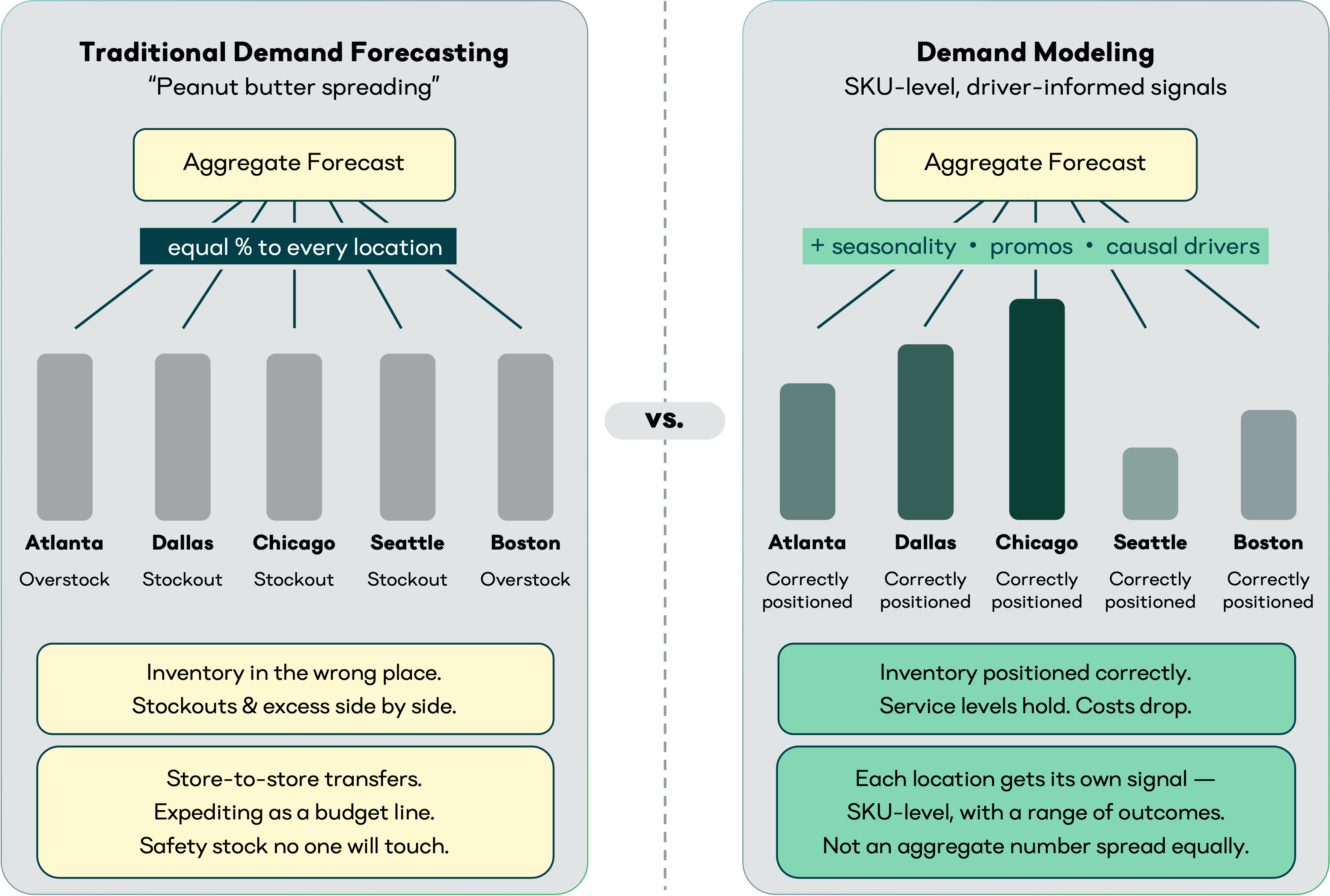
The result? Your supply chain pays for it downstream:
According to research from Gartner, forecast error remains one of the top drivers of excess inventory costs globally — a problem that compounds significantly as decision granularity increases.
A well-structured demand modeling capability isn't trying to replace your existing forecasting process. The goal is to augment it — to take what your demand planning team already produces and translate it into a form that can actually drive better decisions.

Here's what that means in practice:
Knowing whether a SKU exhibits smooth, erratic, lumpy, or intermittent demand fundamentally changes how you plan for it.
Each pattern implies different approaches to inventory, routing, and risk. This step is analytically distinct from forecasting — and often skipped entirely.
Individual SKU-location time series are often noisy, especially for lower-volume items. Strong demand modeling uses signals from higher levels of the product and geographic hierarchy to inform forecasts at the bottom of the tree — borrowing statistical strength from the aggregate while preserving what's unique at the item level.
A seasonal adjustment that works for winter coats doesn't work for ice cream. A promotional lift factor from one region may be completely wrong for another.
Getting these right requires explicit modeling of causal factors — not just seasonal indices applied uniformly across your portfolio.
Perhaps the most underutilized output of demand modeling is probabilistic: the spread of outcomes, not just the median expectation.
When you're making a capacity investment or setting inventory policy, the 75th percentile scenario is often as important as the 50th. A defensible demand signal tells you the range you need to plan across — and what the cost of being wrong in either direction actually is.
Research from MIT's Center for Transportation and Logistics has consistently shown that probabilistic demand representations lead to meaningfully better inventory positioning decisions than point forecasts alone.
And in a world of tariff shifts, supplier disruptions, and demand volatility, a range of outcomes is only useful if you can model the specific scenarios that might push you toward either end of it. Demand modeling makes that possible — letting teams stress-test their supply chain against realistic disruption scenarios before those disruptions arrive, not after.
A clarifying question worth asking: who in your organization needs to defend the demand assumptions behind a supply chain decision?
The answer is usually: a lot of people.
A defensible demand signal isn't just technically accurate. It's explainable. It's tied to observable drivers. It can be stress-tested. And it can be measured over time — so when it's wrong, you know why and can correct the bias.
This is where rigor pays off beyond the numbers. When you can show that your forecast incorporates causal factors, corrects for historical bias, and produces a range of outcomes, you build organizational confidence in supply chain decisions. And confidence is often what separates a recommendation that gets acted on from one that sits in a deck.
Safety stock is supposed to buffer against demand variability. But if your variability estimate is wrong — because it's derived from an aggregate forecast rather than SKU-level modeling — your safety stock will be wrong too.
The math is straightforward: a 1% improvement in forecast accuracy can yield roughly a 0.5% reduction in safety stock. At scale, that adds up quickly.
Capacity investment decisions are almost entirely driven by demand growth projections.
If those projections are based on broad market-level forecasts spread down by equal allocation, you're at real risk of building capacity in the wrong place, at the wrong time, at the wrong scale. Demand modeling that produces regionally specific, SKU-specific, probabilistic growth projections gives your capital investment decisions a much stronger foundation.
And even more powerful application is scenario modeling: running demand projections across multiple futures — different growth trajectories, different sourcing strategies, different market conditions — and understanding which capacity investments hold up across all of them, not just the base case.
Routing optimization is only as good as the demand signal driving it. If your demand inputs don't reflect the actual pattern of customer orders — including seasonality, promotional events, and regional variation — your optimized routes will drift from reality faster than you can recalibrate.
As supply chains have become more dynamic, the case for continuously refreshed network-informed demand signals has never been stronger.
The most valuable thing a demand model can do in a disruptive environment isn't produce a better forecast. It gives your organization a shared, quantified view of what different futures actually look like.
When tariffs shift overnight, when a supplier goes dark, when a competitor collapses and opens new market opportunity — the teams that respond fastest are the ones who already modeled those scenarios. Not because they predicted the future, but because they understood the range of demand realities their supply chain needed to be ready for.
That shared view also changes how decisions get made internally. When finance, operations, logistics, and supply chain leadership are looking at the same scenario outputs — not arguing over whose forecast is right — alignment happens faster and actions follow.

Most organizations don't realize their demand signal is insufficient until the symptoms have already become expensive. Watch for these indicators:
What makes this moment different is that demand modeling no longer has to live in a silo.
The same platform capabilities that power network optimization and scenario planning at Optilogic can now ingest, process, and feed demand signals directly into those models — at the right level of granularity, refreshed continuously, without manual translation steps.
That means supply chain teams can get the benefits of rigorous demand modeling without standing up a separate capability, fighting for access to another team's data, or managing a fragile connection between disconnected tools.
The demand signal, the model, and the decision exist in the same environment. When demand changes — as it inevitably will — the downstream implications can be tested in near real time rather than waiting for the next quarterly planning cycle.
Pulsar, Optilogic's Demand Modeling engine, uses neural network models that learn causal factors, cross-product hierarchies, and probabilistic patterns — producing outputs that flow directly into supply chain design, inventory optimization, and routing decisions.
The question most supply chain leaders should be asking isn't "do we have a demand forecast?" Almost everyone does.
The better question is: Is our demand signal actually informing supply chain decisions at the level of granularity those decisions require?
If the honest answer is no — if decisions are still being made based on allocations from aggregate forecasts, or on safety stock rules of thumb that haven't been revisited in years — that's where the opportunity lives.
Demand modeling isn't a new concept. But the ability to do it rigorously, at scale, integrated directly with optimization and simulation — that's genuinely new. And the supply chain teams that figure it out first will have an input advantage that compounds over every decision they make.
Vikram Srinivasan is VP of Solution Architecture and New Products at Optilogic, where he leads product strategy across supply chain data transformation and analytics, agentic AI, and composable apps.
By Vikram Srinivasan, VP of Solution Architecture and New Products, Optilogic
Supply chain teams lose millions of dollars a year to stockouts, excess inventory, and expediting costs that trace back to a critical factor: demand signals that aren't granular enough to drive the decisions that depend on them.
A monthly forecast at the product family level can look perfectly accurate while simultaneously failing every planner, analyst, and logistics manager who needs SKU-location-level inputs to do their job.
That's the difference between demand forecasting (predicting future volumes for planning purposes) and demand modeling, which goes further — incorporating internal and external drivers of demand to build a holistic view, then translating that into the precise inputs supply chain decisions actually require.
Most companies have the first. Far fewer have the second. And the difference shows up directly in inventory positioning, capacity decisions, routing efficiency, and service levels.
The symptoms are recognizable:
These aren't operations problems. They're demand signal problems — and they're solvable.
Demand forecasting and demand modeling are not the same thing — and treating them as interchangeable is one of the most common and costly mistakes in supply chain planning.
Demand forecasting is about predicting future volumes. It feeds a demand planning process: statistical baseline, consensus from sales and finance, roll-up to a number that drives the next quarter. It's essential, but it's a starting point.
Demand modeling goes deeper. It's about understanding why demand behaves the way it does — seasonality, promotional lift, causal drivers, correlations across products and locations. And critically, it's about translating that understanding into the granularity that actual supply chain decisions require.
"You're not replacing your current company's forecasting process. You're actually leveraging it. You're just adding more information and insights to it and translating it to the right level of granularity for your decision." -Vikram Srinivasan, VP of Solution Architecture and New Products, Optilogic
That's the difference.
Here's the core problem. Most forecasting processes operate at a level of aggregation that's appropriate for demand planning — but not for supply chain design.
You get a top-line forecast. Your teams spread that number down to individual SKUs, locations, and customers using simple allocation rules. What practitioners call "peanut butter spreading" — every location gets roughly the same percentage of the total.
But every customer-SKU combination has its own unique demand pattern. When you wash all of that out into an equal allocation, you're making decisions based on a signal that doesn't reflect reality.
The result? Your supply chain pays for it downstream:
According to research from Gartner, forecast error remains one of the top drivers of excess inventory costs globally — a problem that compounds significantly as decision granularity increases.
A well-structured demand modeling capability isn't trying to replace your existing forecasting process. The goal is to augment it — to take what your demand planning team already produces and translate it into a form that can actually drive better decisions.
Here's what that means in practice:
Knowing whether a SKU exhibits smooth, erratic, lumpy, or intermittent demand fundamentally changes how you plan for it.
Each pattern implies different approaches to inventory, routing, and risk. This step is analytically distinct from forecasting — and often skipped entirely.
Individual SKU-location time series are often noisy, especially for lower-volume items. Strong demand modeling uses signals from higher levels of the product and geographic hierarchy to inform forecasts at the bottom of the tree — borrowing statistical strength from the aggregate while preserving what's unique at the item level.
A seasonal adjustment that works for winter coats doesn't work for ice cream. A promotional lift factor from one region may be completely wrong for another.
Getting these right requires explicit modeling of causal factors — not just seasonal indices applied uniformly across your portfolio.
Perhaps the most underutilized output of demand modeling is probabilistic: the spread of outcomes, not just the median expectation.
When you're making a capacity investment or setting inventory policy, the 75th percentile scenario is often as important as the 50th. A defensible demand signal tells you the range you need to plan across — and what the cost of being wrong in either direction actually is.
Research from MIT's Center for Transportation and Logistics has consistently shown that probabilistic demand representations lead to meaningfully better inventory positioning decisions than point forecasts alone.
And in a world of tariff shifts, supplier disruptions, and demand volatility, a range of outcomes is only useful if you can model the specific scenarios that might push you toward either end of it. Demand modeling makes that possible — letting teams stress-test their supply chain against realistic disruption scenarios before those disruptions arrive, not after.
A clarifying question worth asking: who in your organization needs to defend the demand assumptions behind a supply chain decision?
The answer is usually: a lot of people.
A defensible demand signal isn't just technically accurate. It's explainable. It's tied to observable drivers. It can be stress-tested. And it can be measured over time — so when it's wrong, you know why and can correct the bias.
This is where rigor pays off beyond the numbers. When you can show that your forecast incorporates causal factors, corrects for historical bias, and produces a range of outcomes, you build organizational confidence in supply chain decisions. And confidence is often what separates a recommendation that gets acted on from one that sits in a deck.
Safety stock is supposed to buffer against demand variability. But if your variability estimate is wrong — because it's derived from an aggregate forecast rather than SKU-level modeling — your safety stock will be wrong too.
The math is straightforward: a 1% improvement in forecast accuracy can yield roughly a 0.5% reduction in safety stock. At scale, that adds up quickly.
Capacity investment decisions are almost entirely driven by demand growth projections.
If those projections are based on broad market-level forecasts spread down by equal allocation, you're at real risk of building capacity in the wrong place, at the wrong time, at the wrong scale. Demand modeling that produces regionally specific, SKU-specific, probabilistic growth projections gives your capital investment decisions a much stronger foundation.
And even more powerful application is scenario modeling: running demand projections across multiple futures — different growth trajectories, different sourcing strategies, different market conditions — and understanding which capacity investments hold up across all of them, not just the base case.
Routing optimization is only as good as the demand signal driving it. If your demand inputs don't reflect the actual pattern of customer orders — including seasonality, promotional events, and regional variation — your optimized routes will drift from reality faster than you can recalibrate.
As supply chains have become more dynamic, the case for continuously refreshed network-informed demand signals has never been stronger.
The most valuable thing a demand model can do in a disruptive environment isn't produce a better forecast. It gives your organization a shared, quantified view of what different futures actually look like.
When tariffs shift overnight, when a supplier goes dark, when a competitor collapses and opens new market opportunity — the teams that respond fastest are the ones who already modeled those scenarios. Not because they predicted the future, but because they understood the range of demand realities their supply chain needed to be ready for.
That shared view also changes how decisions get made internally. When finance, operations, logistics, and supply chain leadership are looking at the same scenario outputs — not arguing over whose forecast is right — alignment happens faster and actions follow.
Most organizations don't realize their demand signal is insufficient until the symptoms have already become expensive. Watch for these indicators:
What makes this moment different is that demand modeling no longer has to live in a silo.
The same platform capabilities that power network optimization and scenario planning at Optilogic can now ingest, process, and feed demand signals directly into those models — at the right level of granularity, refreshed continuously, without manual translation steps.
That means supply chain teams can get the benefits of rigorous demand modeling without standing up a separate capability, fighting for access to another team's data, or managing a fragile connection between disconnected tools.
The demand signal, the model, and the decision exist in the same environment. When demand changes — as it inevitably will — the downstream implications can be tested in near real time rather than waiting for the next quarterly planning cycle.
Pulsar, Optilogic's Demand Modeling engine, uses neural network models that learn causal factors, cross-product hierarchies, and probabilistic patterns — producing outputs that flow directly into supply chain design, inventory optimization, and routing decisions.
The question most supply chain leaders should be asking isn't "do we have a demand forecast?" Almost everyone does.
The better question is: Is our demand signal actually informing supply chain decisions at the level of granularity those decisions require?
If the honest answer is no — if decisions are still being made based on allocations from aggregate forecasts, or on safety stock rules of thumb that haven't been revisited in years — that's where the opportunity lives.
Demand modeling isn't a new concept. But the ability to do it rigorously, at scale, integrated directly with optimization and simulation — that's genuinely new. And the supply chain teams that figure it out first will have an input advantage that compounds over every decision they make.
Vikram Srinivasan is VP of Solution Architecture and New Products at Optilogic, where he leads product strategy across supply chain data transformation and analytics, agentic AI, and composable apps.
Fill out the form to unlock the full content
.jpg)