Published by
Published on
March 9, 2026




Your CEO asks about tariff exposure on Thursday. Your board wants sourcing alternatives before next week's meeting. A major supplier just went dark. Your team is still pulling data from three systems, building a model that won't be ready for six weeks.
This isn't a data problem. It's a design velocity problem.
The executives pulling ahead aren't the ones with the biggest teams or the most sophisticated ERP implementations. They're the ones who've transformed supply chain network design from a periodic consulting project into a continuous, always-ready capability. When the question arrives—and it always arrives faster than you expect—they already have a live model, tested scenarios, and a defensible answer. The gap between those organizations and everyone else isn't technology. It's how they've chosen to work.
Supply chain volatility is permanent. In 2023 alone, there were over 400 disasters globally. Layer on geopolitical shifts, tariff volatility, and supplier instability, and most organizations still treat network design as a periodic exercise—something that happens every few years, or when a consultant gets involved.
That structural mismatch is the problem. When disruptions arrive monthly and decisions are needed in days, a network design practice built around annual cycles isn't just slow—it's falling behind.
One global beverage manufacturer recently cut their scenario run times by 96%—dropping from 50 minutes per scenario to just two minutes. That isn't just efficiency. It's the difference between answering a question during the meeting or answering it next week.
John Ames, Jr., Optilogic VP of Business Development, writes in the Journal of Supply Chain Management, Logistics and Procurement:
"This concept of network strategy has changed over the years, from a once-in-a-while thing to creating a digital model to consistently monitor, evaluate, analyse new ways of doing things across the end-to-end supply chain."
Design-mature organizations don't wait for the next consulting engagement. They have scenario readiness built into how they operate. The question isn't whether disruption will arrive. The question is whether your team can respond in days instead of months.
The discipline has expanded beyond facility location and transportation cost minimization. Modern supply chain network design now spans resiliency planning—multi-sourcing strategies, safety stock positioning, and nearshoring trade-offs. It covers tariff exposure by tracing upstream production movement across trade zones to calculate true landed cost. It handles omnichannel strategy, including optimal placement of dark stores and BOPIS integration. It improves inventory policy at the SKU level, including pooling and virtual inventory strategies.
The scope has grown because the questions executives face have grown. Your board isn't just asking where to put the next DC. They're asking what happens to margin if tariffs double, whether a supplier shutdown creates a two-week exposure, and how to balance service levels against working capital.
John Ames notes that "the decisions evaluated are both transformational and non-transformational policies across the supply chain," citing operational, CapEx, S&OP, risk, and regulatory use cases.
When network design only answered one type of question every few years, periodic projects made sense. Now that it answers dozens of question types across multiple time horizons—from this quarter's routing efficiency to a ten-year CapEx plan—the model needs to be live. Not locked in a consultant's deliverable.
Diana Orrego-Moore, Head of Supply Chain Modeling & Optimization at a pharmaceutical distributor, sums it up:
"Simulation helped us answer not just what could happen, but what should happen — and how to operationalize it."
The conventional approach produces one carefully constructed model, delivered after months of data preparation, consultant engagement, and stakeholder alignment. It's a significant investment that yields a single answer to a question that may already be outdated.
Organizations building competitive advantage today have inverted this entirely. Where traditional projects scoped roughly six scenarios, leading teams are now running hundreds—sometimes thousands—of scenarios continuously.
Take a major discount retailer facing hurricane disruption. They didn't run three scenarios. They ran over 600 scenarios in hours, iterating rapidly across sourcing alternatives and routing configurations to keep shelves stocked. That's not an incremental improvement. It's a fundamentally different relationship between the design team and the business.
This volume is impossible with legacy tools that process scenarios sequentially. If one run takes an hour, you can't run 600. You need cloud-native parallel processing.
When your team can refresh a model overnight, test a new tariff assumption in hours, and present three ranked alternatives to the CFO by end of week, the design function stops being a periodic project and becomes a standing strategic capability. The shift from "one model" to "continuous scenario capability" is what separates organizations that answer disruption with confidence from those still assembling data when the window closes.
Ames observes that "getting answers in two to four months now, with sprints along the way to capture findings and value, is a common theme from organisations doing strategy projects." The technology has evolved: "GenAI is also being used to take natural language prompts to interrogate supply chain metrics and automate scenario building, which can be used for anyone in the organisation that needs it."
Continuous design isn't just for specialists anymore. When natural language interfaces let anyone in the organization interrogate the model and generate scenarios, the design capability stops being a bottleneck and starts being infrastructure.
Continuous network decision support doesn't happen without the right data foundation. But for decades, "data foundation" has meant months of manual spreadsheet work.
Traditional approaches required significant aggregation just to make models computationally tractable. Teams spent 70-80% of their project time preparing data—cleansing, mapping, and normalizing inputs before a single scenario could run.
DataStar changes the math. It's Optilogic's AI-powered data transformation engine built specifically for supply chain workflows.
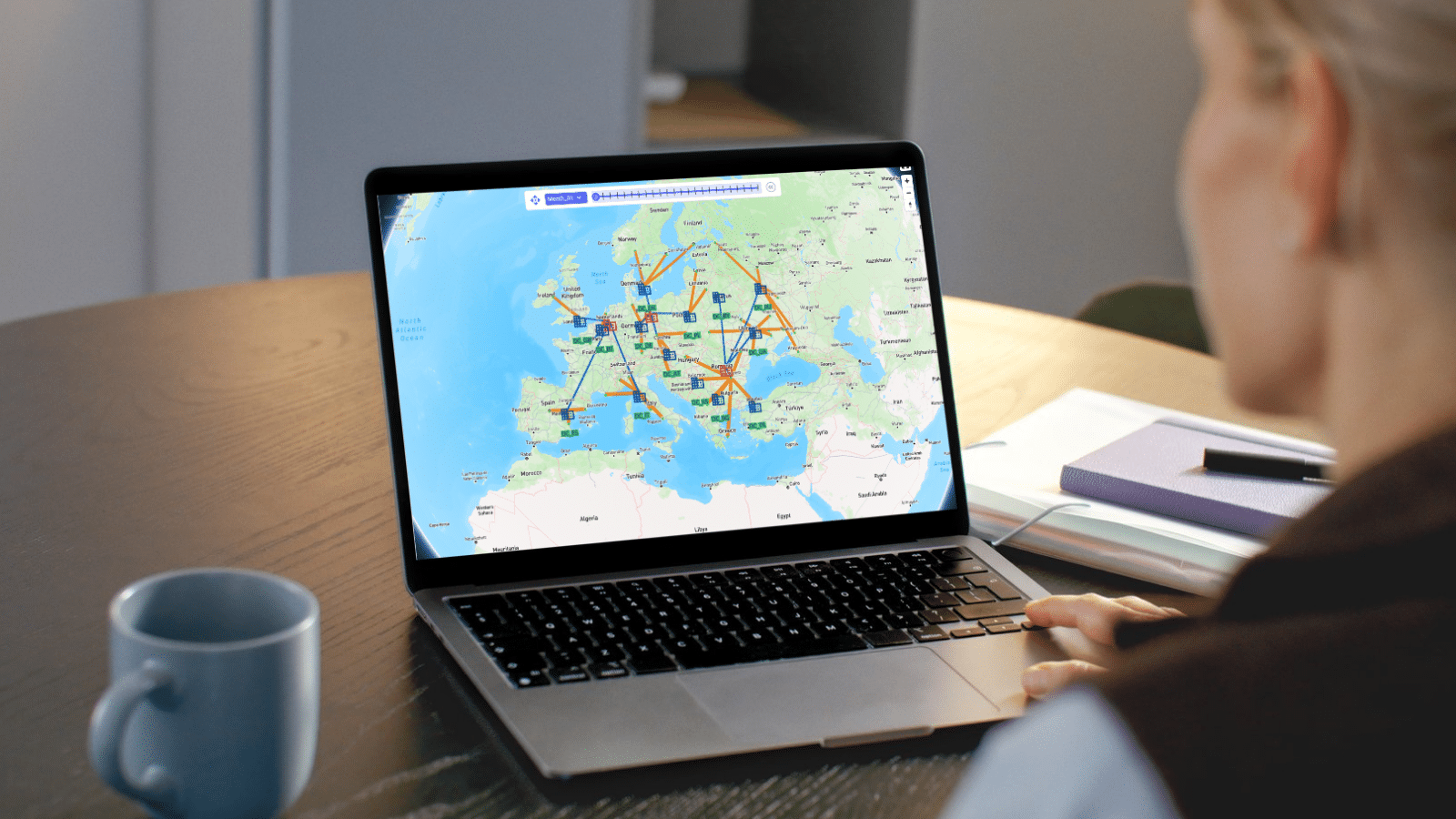
One prompt replaces 40+ steps. Instead of complex SQL queries or chained Excel macros, analysts use natural language prompts to transform data instantly. DataStar connects directly to the Cosmic Frog engine—one unified workflow. Because the platform is cloud-native, you stop aggregating data to save processing power. You model reality.
We're talking about scale that was previously impossible: models with 260,000 products, 23 million transportation policies, and 12 million sourcing policies solving in hours.
Mike Stafiej, Manager of Network Intelligence & Design at General Motors Company, is blunt:
"We haven't been able to create the models the size we're trying to create at, until we partnered with Optilogic."
When you remove performance limits, you stop aggregating. You start modeling reality. Multiple pharma and retail organizations now model at SKU level directly—which means the outputs of a distribution network design scenario can inform a sourcing decision or routing policy without manual disaggregation.
When these inputs are continuously refreshed via DataStar rather than assembled from scratch for each project, the model stays current. The time-to-answer on any new question shrinks from weeks to hours.
The transition is faster than most executives assume. The starting point is establishing a live baseline model: a digital representation of the current network connected to real data sources and validated against actual performance. With the right platform and support, leading organizations reach a working baseline in weeks, not quarters.
Always-on modeling often starts with a single project question. Once a digital twin exists and stakeholders see what it can answer, they generate more questions—naturally, organically, without a new project kickoff.
A supply chain network modeler at a major discount retailer describes the shift:
"Now when something breaks or a new idea comes up, we already have the answer—or we're modeling it."
The model matures. The team builds fluency. The organization develops scenario readiness: the ability to answer any high-stakes network question within days.
A major Midwest grocery chain built a simple application for their routing teams, integrated directly into the execution system, that ran weekly. The result: 10%+ reduction in total miles driven, with downstream improvements to CO₂ metrics and product freshness.
Ames notes that "this weekly run app was integrated into the execution system and powered savings on total miles driven of 10 per cent or more across their network. This reduction in miles impacted CO₂ metrics, product freshness, along with transportation cost efficiencies."
The transition also changes the team's role. Design analysts stop being data janitors and start being strategic advisors. They show up to executive conversations with options already ranked, tradeoffs already quantified, and recommendations already defensible. AI handles the scenario generation. Your people own the strategic direction.
Design velocity translates directly to financial performance. The numbers are drawn from recent project results: total supply chain cost improvements of 5–15%, working capital reductions exceeding $100M, service level improvements of 5–10%, and transportation cost improvements of 30% or more.
One heavy machinery manufacturer used this approach to uncover inventory placement opportunities delivering 22% savings. These aren't theoretical projections. They're outcomes from organizations that made the shift from periodic projects to repeatable, always-ready design capability.
Ames reports that "total supply chain costs of improvements from 5 to 15 per cent, working capital reductions greater than US$100m, service improvements 5–10 per cent and transport costs improved by 30+ per cent have been achieved on some recent projects completed."
These results aren't primarily a function of better algorithms. They're a function of frequency and iteration. A team running four major projects a year will consistently find less value than a team running continuous scenario sprints—not because their tools are worse, but because they're exploring less of the decision space.
Carey Boggess, Director of Footprint Development at United Rentals, Inc., describes the impact of the platform as "intuitive, accessible, affordable, and scalable."
It's whether you build it before your competitors do.
Organizations that treat supply chain network design as a continuous capability—rather than a periodic project—are building a structural advantage that compounds over time. Every scenario they run, every model they refresh, every question they answer in days rather than months widens the gap. The executives who recognize this shift earliest will be positioned to answer the next disruption, the next tariff change, the next board question with confidence rather than a six-week timeline.
Optilogic makes this transition achievable in weeks. With DataStar handling data transformation and Cosmic Frog delivering world-class improvement, you stop building models from scratch and start answering questions. Organizations are establishing working baseline models in 4-6 weeks and running their first strategic scenarios within 8 weeks—turning what used to be a six-month consulting engagement into a standing capability that delivers value in the first quarter.
Request a Demo to see what continuous network decision support looks like on your actual network.
What is supply chain network design?
Supply chain network design is digital twin for your business. It is the process of determining the best location, numbers, and sizes of facilities (like factories and warehouses) and the flow of goods between them. It is the best optimization of your current supply chain.
What is a supply chain digital third twin?
A digital twin replicates your supply chain as it exists today. A "Third Twin" goes further — it uses AI-driven optimization to model the supply chain you should be running. Instead of just showing you what is, it shows you what's possible, with the tradeoffs quantified so your team can make smarter, faster strategic decisions.
What tools do companies use for supply chain network design?
Companies use specialized platforms like Optilogic's Cosmic Frog to model transportation routes, warehouse locations, and sourcing decisions—moving beyond spreadsheets to run hundreds of scenarios in parallel and evaluate global supply chain structures at SKU-level granularity.
How much cost savings can network design deliver?
Organizations using continuous network design capabilities achieve 5-15% reductions in total supply chain costs, 30%+ transportation savings, and working capital reductions exceeding $100M by running continuous scenario sprints instead of periodic consulting projects.
How long does it take to build a supply chain network model?
With modern cloud-native platforms and AI-powered data transformation, teams establish a working baseline digital twin in weeks rather than the traditional three-to-six month timeline—eliminating 70-80% of manual data preparation time.
Your CEO asks about tariff exposure on Thursday. Your board wants sourcing alternatives before next week's meeting. A major supplier just went dark. Your team is still pulling data from three systems, building a model that won't be ready for six weeks.
This isn't a data problem. It's a design velocity problem.
The executives pulling ahead aren't the ones with the biggest teams or the most sophisticated ERP implementations. They're the ones who've transformed supply chain network design from a periodic consulting project into a continuous, always-ready capability. When the question arrives—and it always arrives faster than you expect—they already have a live model, tested scenarios, and a defensible answer. The gap between those organizations and everyone else isn't technology. It's how they've chosen to work.
Supply chain volatility is permanent. In 2023 alone, there were over 400 disasters globally. Layer on geopolitical shifts, tariff volatility, and supplier instability, and most organizations still treat network design as a periodic exercise—something that happens every few years, or when a consultant gets involved.
That structural mismatch is the problem. When disruptions arrive monthly and decisions are needed in days, a network design practice built around annual cycles isn't just slow—it's falling behind.
One global beverage manufacturer recently cut their scenario run times by 96%—dropping from 50 minutes per scenario to just two minutes. That isn't just efficiency. It's the difference between answering a question during the meeting or answering it next week.
John Ames, Jr., Optilogic VP of Business Development, writes in the Journal of Supply Chain Management, Logistics and Procurement:
"This concept of network strategy has changed over the years, from a once-in-a-while thing to creating a digital model to consistently monitor, evaluate, analyse new ways of doing things across the end-to-end supply chain."
Design-mature organizations don't wait for the next consulting engagement. They have scenario readiness built into how they operate. The question isn't whether disruption will arrive. The question is whether your team can respond in days instead of months.
The discipline has expanded beyond facility location and transportation cost minimization. Modern supply chain network design now spans resiliency planning—multi-sourcing strategies, safety stock positioning, and nearshoring trade-offs. It covers tariff exposure by tracing upstream production movement across trade zones to calculate true landed cost. It handles omnichannel strategy, including optimal placement of dark stores and BOPIS integration. It improves inventory policy at the SKU level, including pooling and virtual inventory strategies.
The scope has grown because the questions executives face have grown. Your board isn't just asking where to put the next DC. They're asking what happens to margin if tariffs double, whether a supplier shutdown creates a two-week exposure, and how to balance service levels against working capital.
John Ames notes that "the decisions evaluated are both transformational and non-transformational policies across the supply chain," citing operational, CapEx, S&OP, risk, and regulatory use cases.
When network design only answered one type of question every few years, periodic projects made sense. Now that it answers dozens of question types across multiple time horizons—from this quarter's routing efficiency to a ten-year CapEx plan—the model needs to be live. Not locked in a consultant's deliverable.
Diana Orrego-Moore, Head of Supply Chain Modeling & Optimization at a pharmaceutical distributor, sums it up:
"Simulation helped us answer not just what could happen, but what should happen — and how to operationalize it."
The conventional approach produces one carefully constructed model, delivered after months of data preparation, consultant engagement, and stakeholder alignment. It's a significant investment that yields a single answer to a question that may already be outdated.
Organizations building competitive advantage today have inverted this entirely. Where traditional projects scoped roughly six scenarios, leading teams are now running hundreds—sometimes thousands—of scenarios continuously.
Take a major discount retailer facing hurricane disruption. They didn't run three scenarios. They ran over 600 scenarios in hours, iterating rapidly across sourcing alternatives and routing configurations to keep shelves stocked. That's not an incremental improvement. It's a fundamentally different relationship between the design team and the business.
This volume is impossible with legacy tools that process scenarios sequentially. If one run takes an hour, you can't run 600. You need cloud-native parallel processing.
When your team can refresh a model overnight, test a new tariff assumption in hours, and present three ranked alternatives to the CFO by end of week, the design function stops being a periodic project and becomes a standing strategic capability. The shift from "one model" to "continuous scenario capability" is what separates organizations that answer disruption with confidence from those still assembling data when the window closes.
Ames observes that "getting answers in two to four months now, with sprints along the way to capture findings and value, is a common theme from organisations doing strategy projects." The technology has evolved: "GenAI is also being used to take natural language prompts to interrogate supply chain metrics and automate scenario building, which can be used for anyone in the organisation that needs it."
Continuous design isn't just for specialists anymore. When natural language interfaces let anyone in the organization interrogate the model and generate scenarios, the design capability stops being a bottleneck and starts being infrastructure.
Continuous network decision support doesn't happen without the right data foundation. But for decades, "data foundation" has meant months of manual spreadsheet work.
Traditional approaches required significant aggregation just to make models computationally tractable. Teams spent 70-80% of their project time preparing data—cleansing, mapping, and normalizing inputs before a single scenario could run.
DataStar changes the math. It's Optilogic's AI-powered data transformation engine built specifically for supply chain workflows.
One prompt replaces 40+ steps. Instead of complex SQL queries or chained Excel macros, analysts use natural language prompts to transform data instantly. DataStar connects directly to the Cosmic Frog engine—one unified workflow. Because the platform is cloud-native, you stop aggregating data to save processing power. You model reality.
We're talking about scale that was previously impossible: models with 260,000 products, 23 million transportation policies, and 12 million sourcing policies solving in hours.
Mike Stafiej, Manager of Network Intelligence & Design at General Motors Company, is blunt:
"We haven't been able to create the models the size we're trying to create at, until we partnered with Optilogic."
When you remove performance limits, you stop aggregating. You start modeling reality. Multiple pharma and retail organizations now model at SKU level directly—which means the outputs of a distribution network design scenario can inform a sourcing decision or routing policy without manual disaggregation.
When these inputs are continuously refreshed via DataStar rather than assembled from scratch for each project, the model stays current. The time-to-answer on any new question shrinks from weeks to hours.
The transition is faster than most executives assume. The starting point is establishing a live baseline model: a digital representation of the current network connected to real data sources and validated against actual performance. With the right platform and support, leading organizations reach a working baseline in weeks, not quarters.
Always-on modeling often starts with a single project question. Once a digital twin exists and stakeholders see what it can answer, they generate more questions—naturally, organically, without a new project kickoff.
A supply chain network modeler at a major discount retailer describes the shift:
"Now when something breaks or a new idea comes up, we already have the answer—or we're modeling it."
The model matures. The team builds fluency. The organization develops scenario readiness: the ability to answer any high-stakes network question within days.
A major Midwest grocery chain built a simple application for their routing teams, integrated directly into the execution system, that ran weekly. The result: 10%+ reduction in total miles driven, with downstream improvements to CO₂ metrics and product freshness.
Ames notes that "this weekly run app was integrated into the execution system and powered savings on total miles driven of 10 per cent or more across their network. This reduction in miles impacted CO₂ metrics, product freshness, along with transportation cost efficiencies."
The transition also changes the team's role. Design analysts stop being data janitors and start being strategic advisors. They show up to executive conversations with options already ranked, tradeoffs already quantified, and recommendations already defensible. AI handles the scenario generation. Your people own the strategic direction.
Design velocity translates directly to financial performance. The numbers are drawn from recent project results: total supply chain cost improvements of 5–15%, working capital reductions exceeding $100M, service level improvements of 5–10%, and transportation cost improvements of 30% or more.
One heavy machinery manufacturer used this approach to uncover inventory placement opportunities delivering 22% savings. These aren't theoretical projections. They're outcomes from organizations that made the shift from periodic projects to repeatable, always-ready design capability.
Ames reports that "total supply chain costs of improvements from 5 to 15 per cent, working capital reductions greater than US$100m, service improvements 5–10 per cent and transport costs improved by 30+ per cent have been achieved on some recent projects completed."
These results aren't primarily a function of better algorithms. They're a function of frequency and iteration. A team running four major projects a year will consistently find less value than a team running continuous scenario sprints—not because their tools are worse, but because they're exploring less of the decision space.
Carey Boggess, Director of Footprint Development at United Rentals, Inc., describes the impact of the platform as "intuitive, accessible, affordable, and scalable."
It's whether you build it before your competitors do.
Organizations that treat supply chain network design as a continuous capability—rather than a periodic project—are building a structural advantage that compounds over time. Every scenario they run, every model they refresh, every question they answer in days rather than months widens the gap. The executives who recognize this shift earliest will be positioned to answer the next disruption, the next tariff change, the next board question with confidence rather than a six-week timeline.
Optilogic makes this transition achievable in weeks. With DataStar handling data transformation and Cosmic Frog delivering world-class improvement, you stop building models from scratch and start answering questions. Organizations are establishing working baseline models in 4-6 weeks and running their first strategic scenarios within 8 weeks—turning what used to be a six-month consulting engagement into a standing capability that delivers value in the first quarter.
Request a Demo to see what continuous network decision support looks like on your actual network.
What is supply chain network design?
Supply chain network design is digital twin for your business. It is the process of determining the best location, numbers, and sizes of facilities (like factories and warehouses) and the flow of goods between them. It is the best optimization of your current supply chain.
What is a supply chain digital third twin?
A digital twin replicates your supply chain as it exists today. A "Third Twin" goes further — it uses AI-driven optimization to model the supply chain you should be running. Instead of just showing you what is, it shows you what's possible, with the tradeoffs quantified so your team can make smarter, faster strategic decisions.
What tools do companies use for supply chain network design?
Companies use specialized platforms like Optilogic's Cosmic Frog to model transportation routes, warehouse locations, and sourcing decisions—moving beyond spreadsheets to run hundreds of scenarios in parallel and evaluate global supply chain structures at SKU-level granularity.
How much cost savings can network design deliver?
Organizations using continuous network design capabilities achieve 5-15% reductions in total supply chain costs, 30%+ transportation savings, and working capital reductions exceeding $100M by running continuous scenario sprints instead of periodic consulting projects.
How long does it take to build a supply chain network model?
With modern cloud-native platforms and AI-powered data transformation, teams establish a working baseline digital twin in weeks rather than the traditional three-to-six month timeline—eliminating 70-80% of manual data preparation time.
Fill out the form to unlock the full content
.jpg)