Published by
Joris Wijpkema
Published on
May 13, 2026




In Formula One, you spend months engineering the car: aerodynamics, power unit, fuel strategy. Then you race it. But the track changes every Grand Prix. Weather shifts. Tire compounds behave differently. What wins in Barcelona loses in Monaco.
The best teams don't just drive the car they built. They re-engineer the setup between sessions, sometimes between laps.
Supply chains are catching up. Where facilities sit, which suppliers you use, how product flows across the network: these used to be design decisions, made once and executed against for years. Planning happened separately, adjusting the plan you'd been handed. That split assumed a stable track. The track stopped being stable.
Shocks now demand structural responses, not schedule tweaks. In the first half of 2025, the effective tariff rate on US imports swung from roughly 5% to above 30% and back. Crude oil futures dropped nearly 10% in days on geopolitical shifts. You can't replan your way out of a swing that size. You have to redesign the network under it: new sourcing, nearshored production, restructured logistics. A pit strategy built for a dry race doesn't survive rain. A network built for 5% tariffs doesn't survive 30%.
Compute stopped being the constraint. Full-granularity optimization, millions of orders, hundreds of thousands of SKUs, used to require heavy aggregation just to run. Design models operated coarser than planning systems, which limited how actionable they were. That constraint is gone. General Motors now runs a network model with 180,000 SKUs on Optilogic, a model that used to be chunked into pieces just to process. Teams used to simplify their simulations to fit the compute they had trackside. Now the compute keeps up with the math. So does the modeling.
Everyone works off the same live data now. An F1 pit wall and garage read the same telemetry in real time. No one waits for the post-race debrief to adjust. Supply chains are getting wired the same way: composable apps put scenario results and KPI dashboards in front of business users the moment they're ready, not the moment the next annual review rolls around.
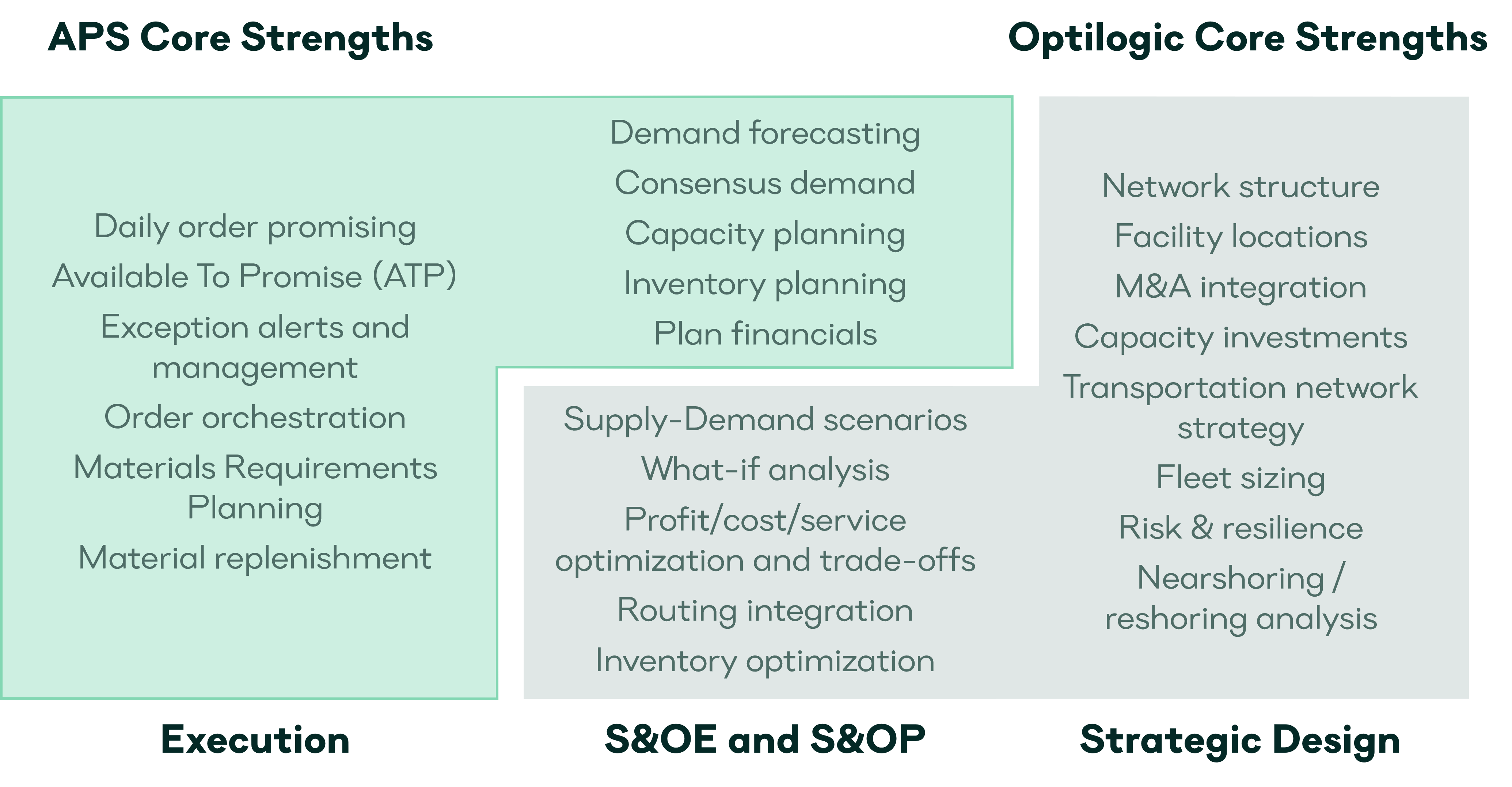
APS was never built to answer these questions. APS platforms handle operational planning well: demand forecasting, capacity and inventory planning, order promising, MRP, S&OP execution. But five capabilities supply chain leaders now need sit outside that architecture:
Without them, networks stay structurally suboptimized. That's not a feature gap APS vendors can patch. The computational approach underneath is different.
Formula One teams don't choose between the engine and the aero package. They need both, tuned to work together. Supply chains face the same non-choice.
A CPU is general purpose: a small number of powerful cores executing instructions in sequence. A GPU is purpose-built: millions of variables, solved in parallel. Neither replaces the other.
APS is the CPU of supply chain planning. Optimization is the GPU. APS defines the best plan given your network. Optimization defines the best network given your strategy. Most leaders now need both answers at once.
That overlap, S&OE and S&OP, is where this plays out. APS owns the core planning process. But the scenario-heavy, optimization-intensive decisions inside that same horizon, supply-demand trade-offs, routing integration, inventory optimization across multiple objectives, need a purpose-built optimization engine. Optilogic's models, engines, and solvers do exactly that. Connected by DataStar pipelines that keep models current, the two systems form one planning architecture, not two competing ones.
This shows up everywhere:
Each one requires structural analysis APS was never architected to deliver.
Extend the model you already built. A network model designed to optimize a single year can be restructured as a 12-to-18-month rolling model with inventory bridges between periods. Mapped onto your S&OP cadence, it becomes an ongoing planning tool instead of a periodic project.
Close your worst APS gap. One organization we work with managed volumes and service levels well in their APS but couldn't factor full financial data into allocation decisions, so they were sourcing and distributing without end-to-end P&L visibility. Running Optilogic alongside their existing system closed that one gap. Nothing else changed.
The processing power exists. The integration patterns are proven. The math works.
What's left is building the habit: asking structural questions on a planning cadence, not just at the annual review. Training teams to use the degrees of freedom modern optimization gives them. Keeping data pipelines current enough to inform the next decision, not validate the last one. The half-life of a network design decision is shrinking. The organizations that see this first are the ones closing the gap between strategy and execution, and they'll be the ones standing when the next disruption lands.
Formula One stopped treating the car and the setup as separate jobs decades ago. The car is a starting point. What you do with it between sessions is what wins races.
Supply chains are catching up. The network you built is a starting point. What you do with it between now and the next disruption is what wins the business: optimize what you have, design what you need, on one platform, continuously. That's what turns a multi-month study into a decision you make in a day.
In Formula One, you spend months engineering the car: aerodynamics, power unit, fuel strategy. Then you race it. But the track changes every Grand Prix. Weather shifts. Tire compounds behave differently. What wins in Barcelona loses in Monaco.
The best teams don't just drive the car they built. They re-engineer the setup between sessions, sometimes between laps.
Supply chains are catching up. Where facilities sit, which suppliers you use, how product flows across the network: these used to be design decisions, made once and executed against for years. Planning happened separately, adjusting the plan you'd been handed. That split assumed a stable track. The track stopped being stable.
Shocks now demand structural responses, not schedule tweaks. In the first half of 2025, the effective tariff rate on US imports swung from roughly 5% to above 30% and back. Crude oil futures dropped nearly 10% in days on geopolitical shifts. You can't replan your way out of a swing that size. You have to redesign the network under it: new sourcing, nearshored production, restructured logistics. A pit strategy built for a dry race doesn't survive rain. A network built for 5% tariffs doesn't survive 30%.
Compute stopped being the constraint. Full-granularity optimization, millions of orders, hundreds of thousands of SKUs, used to require heavy aggregation just to run. Design models operated coarser than planning systems, which limited how actionable they were. That constraint is gone. General Motors now runs a network model with 180,000 SKUs on Optilogic, a model that used to be chunked into pieces just to process. Teams used to simplify their simulations to fit the compute they had trackside. Now the compute keeps up with the math. So does the modeling.
Everyone works off the same live data now. An F1 pit wall and garage read the same telemetry in real time. No one waits for the post-race debrief to adjust. Supply chains are getting wired the same way: composable apps put scenario results and KPI dashboards in front of business users the moment they're ready, not the moment the next annual review rolls around.
APS was never built to answer these questions. APS platforms handle operational planning well: demand forecasting, capacity and inventory planning, order promising, MRP, S&OP execution. But five capabilities supply chain leaders now need sit outside that architecture:
Without them, networks stay structurally suboptimized. That's not a feature gap APS vendors can patch. The computational approach underneath is different.
Formula One teams don't choose between the engine and the aero package. They need both, tuned to work together. Supply chains face the same non-choice.
A CPU is general purpose: a small number of powerful cores executing instructions in sequence. A GPU is purpose-built: millions of variables, solved in parallel. Neither replaces the other.
APS is the CPU of supply chain planning. Optimization is the GPU. APS defines the best plan given your network. Optimization defines the best network given your strategy. Most leaders now need both answers at once.
That overlap, S&OE and S&OP, is where this plays out. APS owns the core planning process. But the scenario-heavy, optimization-intensive decisions inside that same horizon, supply-demand trade-offs, routing integration, inventory optimization across multiple objectives, need a purpose-built optimization engine. Optilogic's models, engines, and solvers do exactly that. Connected by DataStar pipelines that keep models current, the two systems form one planning architecture, not two competing ones.
This shows up everywhere:
Each one requires structural analysis APS was never architected to deliver.
Extend the model you already built. A network model designed to optimize a single year can be restructured as a 12-to-18-month rolling model with inventory bridges between periods. Mapped onto your S&OP cadence, it becomes an ongoing planning tool instead of a periodic project.
Close your worst APS gap. One organization we work with managed volumes and service levels well in their APS but couldn't factor full financial data into allocation decisions, so they were sourcing and distributing without end-to-end P&L visibility. Running Optilogic alongside their existing system closed that one gap. Nothing else changed.
The processing power exists. The integration patterns are proven. The math works.
What's left is building the habit: asking structural questions on a planning cadence, not just at the annual review. Training teams to use the degrees of freedom modern optimization gives them. Keeping data pipelines current enough to inform the next decision, not validate the last one. The half-life of a network design decision is shrinking. The organizations that see this first are the ones closing the gap between strategy and execution, and they'll be the ones standing when the next disruption lands.
Formula One stopped treating the car and the setup as separate jobs decades ago. The car is a starting point. What you do with it between sessions is what wins races.
Supply chains are catching up. The network you built is a starting point. What you do with it between now and the next disruption is what wins the business: optimize what you have, design what you need, on one platform, continuously. That's what turns a multi-month study into a decision you make in a day.
Fill out the form to download the full content
.jpg)