Published by
Published on
August 11, 2026
.jpg)



At a Glance: Supply chain network design and daily execution work best as one connected loop, not two separate disciplines.
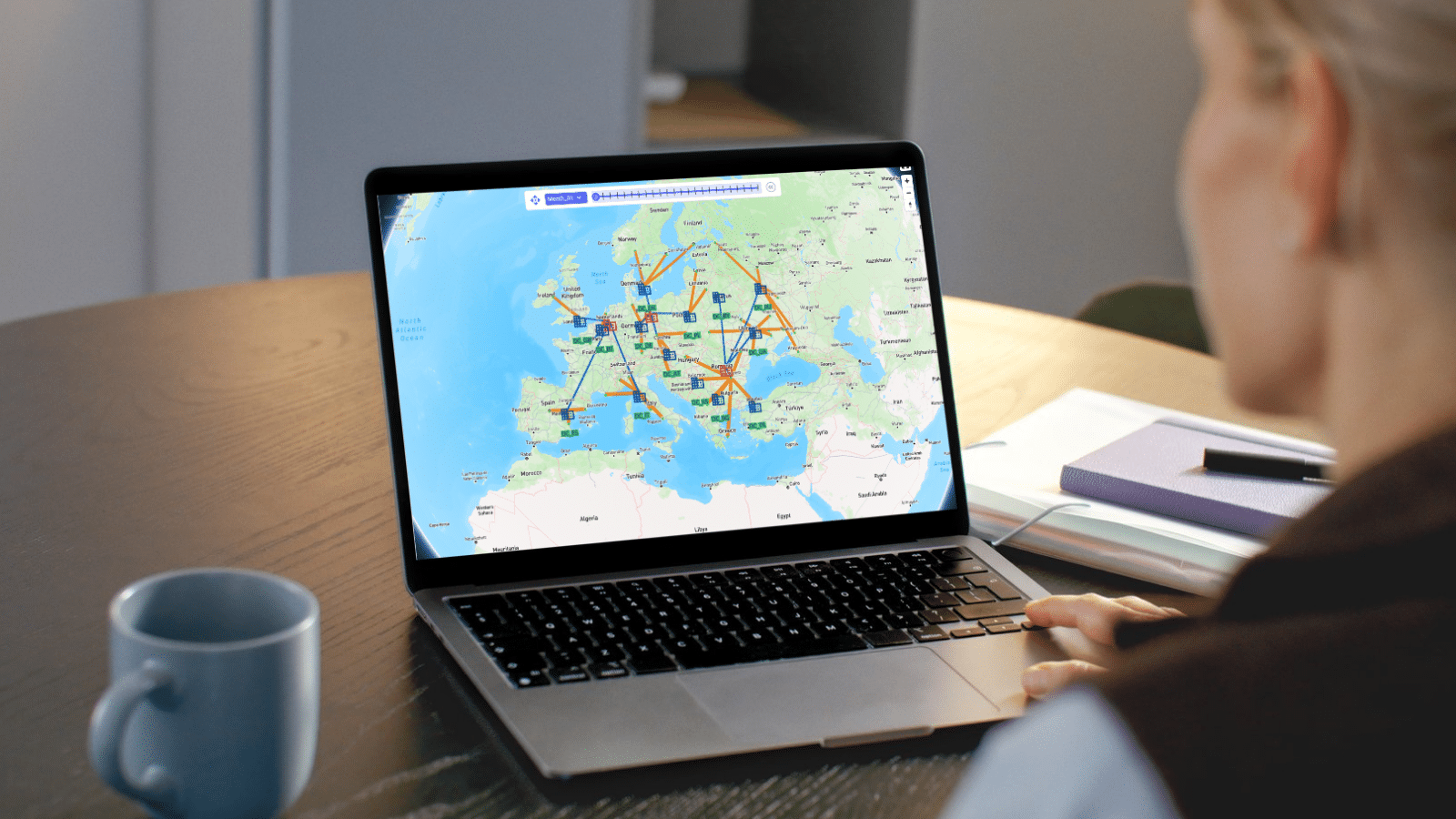
Optilogic designs the network — structure, capacity, inventory, and fleet strategy — while ORTEC executes it day to day through routing, dispatch, and real-time monitoring, with execution data flowing back to refine the next design cycle. In one case, this approach took a distributor from 61 distribution centers to 37 and cut logistics cost from $132.7M to $117.6M.
A joint perspective from ORTEC and Optilogic
Every network design team has experienced this before: the model is completed, the map looks clean, every distribution center sits inside its service radius, every SLA is met on paper. Then the actual Monday-morning order file lands, and none of it quite holds.
ORTEC’s George Ninikas calls this the optimization paradox. A DC sized against a full year of averaged demand fails the week when real volumes spike in one territory and vanish in another. Or the failure runs the other way: two routes engineered to perfection out of one DC turn out wrong once you check the DC one territory over — the one that could have served those stops better, and cheaper, all along.
A brilliant execution engine can’t repair a flawed network design, and a brilliant design decays fast without execution data feeding back into it. Most organizations run one strategic network study a year; by the time it’s completed, several assumptions behind it have already changed. Design and execution work as one continuous loop: strategy sets the structure, execution reveals what holds up, and that feedback sharpens the next design cycle — instead of waiting for next year’s study to catch up.
Neither company claims it can do this alone. Ninikas likes to repeat something he first heard from Optilogic’s CTO, Steve Sommer, in a joint pitch to a prospective customer: the ideal is one vendor and one system covering strategy through real-time execution — and that vendor doesn’t exist. The realistic next-best option is two companies that already think alike, partnering instead of quietly competing for the same slice of the problem.
Optilogic owns the strategic design layer — network structure, capacity and inventory decisions, transportation strategy, fleet sizing and mix. ORTEC owns the execution layer — routing, load building, dispatch, real-time monitoring. Between them, actual transit times, congestion patterns, and delivery-window performance flow back through Optilogic’s DataStar into the design layer, sharpening every model refresh.
A mid-market distributor that grew through a string of acquisitions ended up running 61 distribution centers, overlapping territories, and a fleet cobbled together with no centralized inbound strategy. Optilogic and ORTEC worked it as three connected tiers: network and inventory strategy consolidated the footprint — including splitting dry goods into a dedicated four-DC network separate from bulk; fleet optimization right-sized the truck count and identified cross-dock hubs; and ORTEC’s routing engine ran daily execution, feeding real transit and utilization data back into the model.
The result: 61 distribution centers became 37, the fleet shrank by 109 assets, and logistics cost dropped from $132.7 million to $117.6 million — roughly 11% out of the cost base, split between $11 million in network and cross-docking savings and $4 million from routing and the resulting feedback into the model.
At Optilogic’s OptiCon event, ORTEC ran a live demo on staged Atlanta data to show the loop in action — not a specific customer’s live system. Driver territories were pre-built from historical patterns. Then the actual order file landed — 160,000 pounds, 30,000 cases, 167 stops — and looked nothing like the forecast: one region expected to be busy had almost no orders, another spiked hard.
A single click re-optimized the day’s routes against real traffic patterns, legal drive-time limits, and customer-specific rules like required equipment and security clearances. Twenty-nine deliveries didn’t fit the first pass, because the optimizer enforces hard constraints rather than overriding them. The team guessed five extra routes were needed; the optimizer determined only two or three actually were. Every route stayed editable by hand, and once trucks rolled, driver-app and telematics data flowed back into the same system feeding the design models.
Both companies are candid the partnership is young — under six months old, with parts of the technical integration still being built. The underlying technology is proven: ORTEC has solved vehicle and workforce optimization problems since 1981 for customers including Coca-Cola, Procter & Gamble, and DHL; Optilogic’s design engines have been tested against equally complex networks. What decides whether a partnership like this pays off is whether an organization has the innovation culture to adopt it — a willingness to pilot fast, learn fast, and try again, backed by genuine change management.
If your network design and your daily execution are still running as two separate conversations, that’s the gap this partnership was built to close.
A network design models demand against representative averages, so it can’t predict a specific week’s spike or lull. What closes the gap is treating network design and daily execution as connected: the network model sets the structure — DC locations, capacity, fleet size — and execution data on actual order volumes and congestion feeds back to sharpen the next model refresh.
Fleet sizing and daily routing answer different questions. In the case above, Optilogic’s Cosmic Frog right-sized the fleet against the redesigned network — eliminating 109 assets — while ORTEC’s routing engine handled daily route building / estimating drivers etc. against that fleet. Run on connected data, the two decisions reinforce each other.
Actual transit times, delivery-window performance, and driver behavior captured during execution flow back through Optilogic’s DataStar into the design layer. A lane that looked like a two-day route on paper but consistently runs three days in practice gets corrected in the next model refresh, instead of surfacing only at the next annual planning cycle.
About ORTEC
ORTEC is a global provider of supply chain planning and workforce management software, helping organizations optimize the use of their people and resources through trusted, AI-powered solutions. For over 40 years, ORTEC’s mission has been to deliver technology that enables companies to achieve greater efficiency, reliability, and human-centric innovation across their operations. ORTEC is backed by Battery Ventures. Discover more about ORTEC at ortec.com.
A joint perspective from ORTEC and Optilogic
Every network design team has experienced this before: the model is completed, the map looks clean, every distribution center sits inside its service radius, every SLA is met on paper. Then the actual Monday-morning order file lands, and none of it quite holds.
ORTEC’s George Ninikas calls this the optimization paradox. A DC sized against a full year of averaged demand fails the week when real volumes spike in one territory and vanish in another. Or the failure runs the other way: two routes engineered to perfection out of one DC turn out wrong once you check the DC one territory over — the one that could have served those stops better, and cheaper, all along.
A brilliant execution engine can’t repair a flawed network design, and a brilliant design decays fast without execution data feeding back into it. Most organizations run one strategic network study a year; by the time it’s completed, several assumptions behind it have already changed. Design and execution work as one continuous loop: strategy sets the structure, execution reveals what holds up, and that feedback sharpens the next design cycle — instead of waiting for next year’s study to catch up.
Neither company claims it can do this alone. Ninikas likes to repeat something he first heard from Optilogic’s CTO, Steve Sommer, in a joint pitch to a prospective customer: the ideal is one vendor and one system covering strategy through real-time execution — and that vendor doesn’t exist. The realistic next-best option is two companies that already think alike, partnering instead of quietly competing for the same slice of the problem.
Optilogic owns the strategic design layer — network structure, capacity and inventory decisions, transportation strategy, fleet sizing and mix. ORTEC owns the execution layer — routing, load building, dispatch, real-time monitoring. Between them, actual transit times, congestion patterns, and delivery-window performance flow back through Optilogic’s DataStar into the design layer, sharpening every model refresh.
A mid-market distributor that grew through a string of acquisitions ended up running 61 distribution centers, overlapping territories, and a fleet cobbled together with no centralized inbound strategy. Optilogic and ORTEC worked it as three connected tiers: network and inventory strategy consolidated the footprint — including splitting dry goods into a dedicated four-DC network separate from bulk; fleet optimization right-sized the truck count and identified cross-dock hubs; and ORTEC’s routing engine ran daily execution, feeding real transit and utilization data back into the model.
The result: 61 distribution centers became 37, the fleet shrank by 109 assets, and logistics cost dropped from $132.7 million to $117.6 million — roughly 11% out of the cost base, split between $11 million in network and cross-docking savings and $4 million from routing and the resulting feedback into the model.
At Optilogic’s OptiCon event, ORTEC ran a live demo on staged Atlanta data to show the loop in action — not a specific customer’s live system. Driver territories were pre-built from historical patterns. Then the actual order file landed — 160,000 pounds, 30,000 cases, 167 stops — and looked nothing like the forecast: one region expected to be busy had almost no orders, another spiked hard.
A single click re-optimized the day’s routes against real traffic patterns, legal drive-time limits, and customer-specific rules like required equipment and security clearances. Twenty-nine deliveries didn’t fit the first pass, because the optimizer enforces hard constraints rather than overriding them. The team guessed five extra routes were needed; the optimizer determined only two or three actually were. Every route stayed editable by hand, and once trucks rolled, driver-app and telematics data flowed back into the same system feeding the design models.
Both companies are candid the partnership is young — under six months old, with parts of the technical integration still being built. The underlying technology is proven: ORTEC has solved vehicle and workforce optimization problems since 1981 for customers including Coca-Cola, Procter & Gamble, and DHL; Optilogic’s design engines have been tested against equally complex networks. What decides whether a partnership like this pays off is whether an organization has the innovation culture to adopt it — a willingness to pilot fast, learn fast, and try again, backed by genuine change management.
If your network design and your daily execution are still running as two separate conversations, that’s the gap this partnership was built to close.
A network design models demand against representative averages, so it can’t predict a specific week’s spike or lull. What closes the gap is treating network design and daily execution as connected: the network model sets the structure — DC locations, capacity, fleet size — and execution data on actual order volumes and congestion feeds back to sharpen the next model refresh.
Fleet sizing and daily routing answer different questions. In the case above, Optilogic’s Cosmic Frog right-sized the fleet against the redesigned network — eliminating 109 assets — while ORTEC’s routing engine handled daily route building / estimating drivers etc. against that fleet. Run on connected data, the two decisions reinforce each other.
Actual transit times, delivery-window performance, and driver behavior captured during execution flow back through Optilogic’s DataStar into the design layer. A lane that looked like a two-day route on paper but consistently runs three days in practice gets corrected in the next model refresh, instead of surfacing only at the next annual planning cycle.
About ORTEC
ORTEC is a global provider of supply chain planning and workforce management software, helping organizations optimize the use of their people and resources through trusted, AI-powered solutions. For over 40 years, ORTEC’s mission has been to deliver technology that enables companies to achieve greater efficiency, reliability, and human-centric innovation across their operations. ORTEC is backed by Battery Ventures. Discover more about ORTEC at ortec.com.
Fill out the form to unlock the full content
.jpg)