Published by
Published on
July 21, 2026




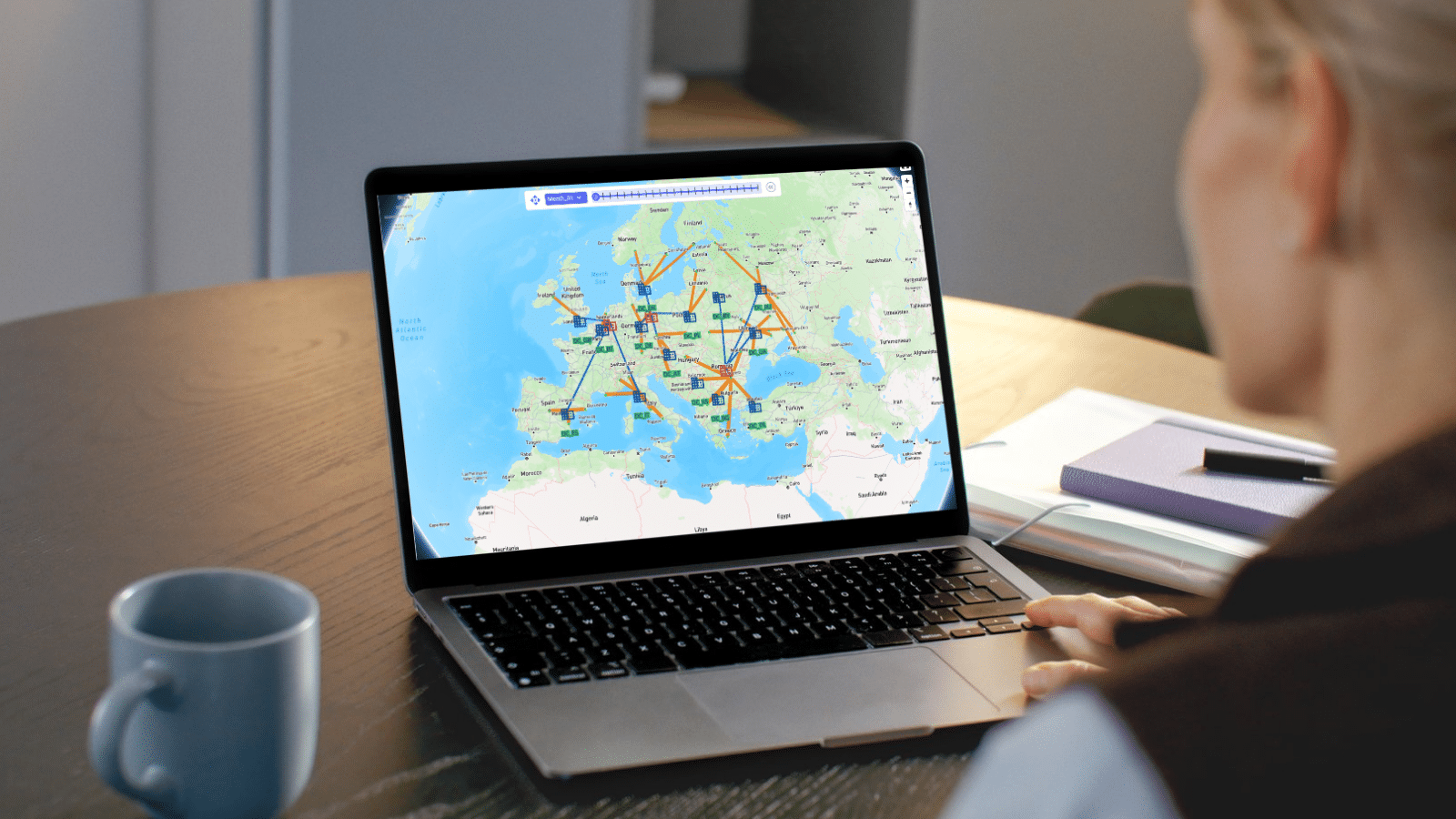
Cosmic Frog's new MEIO engine, Cyclo, optimizes safety stock placement across your entire supply chain simultaneously. Reduce inventory costs, maintain service levels, and make decisions you can actually operationalize.
Most supply chain teams know they're carrying too much inventory somewhere and not enough somewhere else. Teams often approach the problem by looking node by node and making necessary adjustments. However, it's much more effective to solve at the network level.
Inventory decisions made in isolation are costly. For example, if you buffer too much at a downstream DC, then you're carrying unnecessary holding costs. But if you buffer too little upstream, then you're exposed when a supplier lead time shifts or demand spikes. And when every location optimizes independently, the same variability gets buffered multiple times across the network, creating a hidden tax that compounds across every product and every lane.
Cyclo, Cosmic Frog's new Multi Echelon Inventory Optimization (MEIO) engine, changes that. It evaluates your entire supply chain network simultaneously to pinpoint exactly where safety stock should be held, how much is needed at each stage, and how your service level targets translate into real inventory requirements and cost — all in one solve. The goal is to hit your service targets without over-investing in inventory.
Multi Echelon Inventory Optimization, or MEIO, is a planning approach that optimizes safety stock across an entire supply chain network rather than at individual locations.
Traditional inventory planning treats each node independently. A DC calculates its safety stock based on its own demand variability and lead times. A plant does the same. A regional warehouse does the same. The result is duplicated buffers across the network and no visibility into how decisions at one stage affect another.
MEIO takes a fundamentally different approach. Rather than optimizing each node independently, it models the entire network as a connected system: suppliers, plants, distribution centers, and customer-facing locations. The result is inventory positioning that minimizes total holding cost while achieving your target service level.
For supply chains operating across multiple stages and geographies, it's a different way of thinking about inventory entirely.
Cyclo uses a Guaranteed Service Model (GSM) approach. Rather than directly setting safety stock quantities, it optimizes the service-time commitments between facilities: how long each stage expects to wait for replenishment and how quickly it commits to serving the next stage downstream. Those service-time decisions are then translated into safety stock requirements.
The result is a network that buffers variability strategically, concentrating inventory where it is most cost-effective rather than distributing it by default.
A simple example illustrates the difference.
Consider a product flowing from a manufacturer to a distribution center to a customer, with a total network lead time of five days.
Without MEIO, the DC might carry five full days of safety stock to guarantee customer responsiveness — absorbing all the uncertainty itself. With Cyclo, the optimizer evaluates multiple configurations:
Cyclo evaluates all these configurations across every product-location combination in your network and surfaces the option that minimizes total safety stock holding cost while hitting your target service level. No manual scenario building required.
Cyclo is built for supply chain teams that need to answer questions that single-node inventory tools simply can't address:
What you can model with Cyclo:
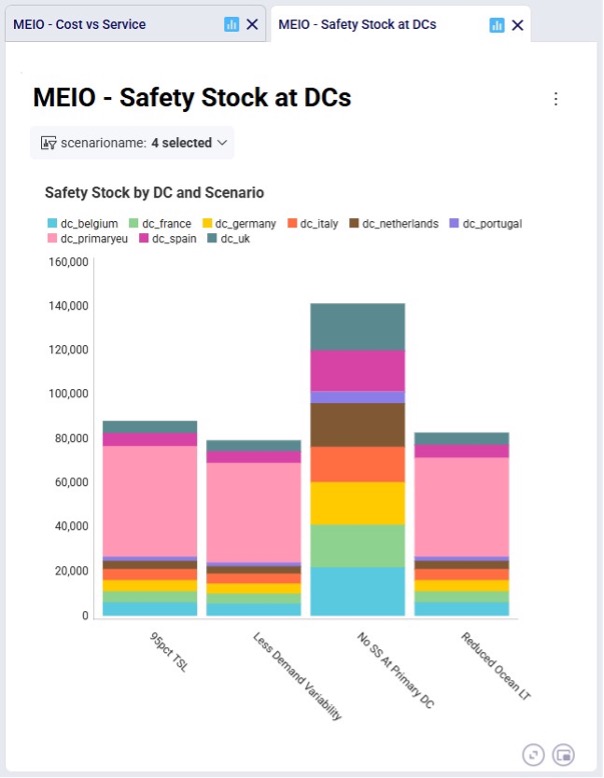
Pooling reduces total safety stock. Centralizing safety stock at a shared hub absorbs variability that would otherwise be duplicated when every downstream location buffers independently, a counterintuitive result that node-by-node planning would miss entirely.
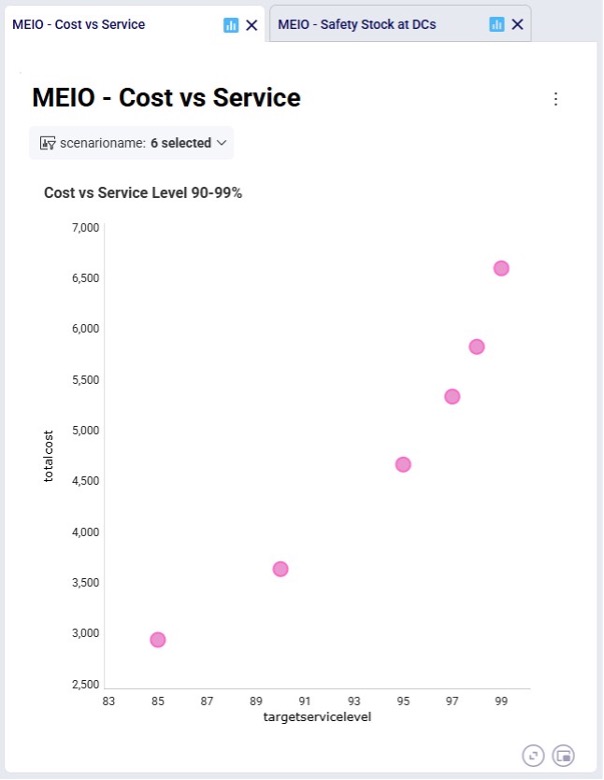
Service costs rise steeply near the top. As a target service level approaches 99%, the cost of each additional point increases sharply, a pattern worth seeing before you commit to a service target.
Cyclo tells you where safety stock should be positioned and how much is needed. But knowing the answer and being able to operationalize it are two different things.
Dendro, Cosmic Frog's simulation-optimization engine, is purpose-built for right-sizing inventory policies and stress-testing them against real-world variability before you commit. Where Cyclo optimizes at the network level, Dendro lets you simulate how those inventory policies perform under realistic demand patterns, lead time uncertainty, and replenishment timing, all before anything changes in practice.
Used together, the workflow is clear:
The result is more accurate recommendations you can act on with confidence: strategic inventory positioning from Cyclo, validated and refined through Dendro before you commit.
Cyclo is available now in Cosmic Frog for all users. A template model in the Resource Library, includes preconfigured scenarios across service level targets, lead time changes, and network configurations so you can explore the outputs immediately.
See a Quick Demo of Cyclo
In this video, watch Neeru Bhopal, Director or Product Management at Optilogic, explain the benefits of MEIO in Cosmic Frog.
Ready to optimize your inventory network?
For detailed configuration guidance, visit the Cyclo Help Center documentation. Have questions? Reach out to your Customer Success Manager or contact support@optilogic.com.
About Optilogic
Optilogic is an AI-first supply chain design company that revolutionizes decision-making by transforming modeling from a three-month project into one-day breakthroughs. We combine AI, mathematical optimization, and simulation to help enterprises shift from data preparation to strategic network design decisions. Our platform empowers teams to answer critical what-if questions in real time and optimize complex supply chain networks, while our Solutions team provides hands-on expertise to ensure rapid success. Learn more at optilogic.com.
Cosmic Frog's new MEIO engine, Cyclo, optimizes safety stock placement across your entire supply chain simultaneously. Reduce inventory costs, maintain service levels, and make decisions you can actually operationalize.
Most supply chain teams know they're carrying too much inventory somewhere and not enough somewhere else. Teams often approach the problem by looking node by node and making necessary adjustments. However, it's much more effective to solve at the network level.
Inventory decisions made in isolation are costly. For example, if you buffer too much at a downstream DC, then you're carrying unnecessary holding costs. But if you buffer too little upstream, then you're exposed when a supplier lead time shifts or demand spikes. And when every location optimizes independently, the same variability gets buffered multiple times across the network, creating a hidden tax that compounds across every product and every lane.
Cyclo, Cosmic Frog's new Multi Echelon Inventory Optimization (MEIO) engine, changes that. It evaluates your entire supply chain network simultaneously to pinpoint exactly where safety stock should be held, how much is needed at each stage, and how your service level targets translate into real inventory requirements and cost — all in one solve. The goal is to hit your service targets without over-investing in inventory.
Multi Echelon Inventory Optimization, or MEIO, is a planning approach that optimizes safety stock across an entire supply chain network rather than at individual locations.
Traditional inventory planning treats each node independently. A DC calculates its safety stock based on its own demand variability and lead times. A plant does the same. A regional warehouse does the same. The result is duplicated buffers across the network and no visibility into how decisions at one stage affect another.
MEIO takes a fundamentally different approach. Rather than optimizing each node independently, it models the entire network as a connected system: suppliers, plants, distribution centers, and customer-facing locations. The result is inventory positioning that minimizes total holding cost while achieving your target service level.
For supply chains operating across multiple stages and geographies, it's a different way of thinking about inventory entirely.
Cyclo uses a Guaranteed Service Model (GSM) approach. Rather than directly setting safety stock quantities, it optimizes the service-time commitments between facilities: how long each stage expects to wait for replenishment and how quickly it commits to serving the next stage downstream. Those service-time decisions are then translated into safety stock requirements.
The result is a network that buffers variability strategically, concentrating inventory where it is most cost-effective rather than distributing it by default.
A simple example illustrates the difference.
Consider a product flowing from a manufacturer to a distribution center to a customer, with a total network lead time of five days.
Without MEIO, the DC might carry five full days of safety stock to guarantee customer responsiveness — absorbing all the uncertainty itself. With Cyclo, the optimizer evaluates multiple configurations:
Cyclo evaluates all these configurations across every product-location combination in your network and surfaces the option that minimizes total safety stock holding cost while hitting your target service level. No manual scenario building required.
Cyclo is built for supply chain teams that need to answer questions that single-node inventory tools simply can't address:
What you can model with Cyclo:
Pooling reduces total safety stock. Centralizing safety stock at a shared hub absorbs variability that would otherwise be duplicated when every downstream location buffers independently, a counterintuitive result that node-by-node planning would miss entirely.
Service costs rise steeply near the top. As a target service level approaches 99%, the cost of each additional point increases sharply, a pattern worth seeing before you commit to a service target.
Cyclo tells you where safety stock should be positioned and how much is needed. But knowing the answer and being able to operationalize it are two different things.
Dendro, Cosmic Frog's simulation-optimization engine, is purpose-built for right-sizing inventory policies and stress-testing them against real-world variability before you commit. Where Cyclo optimizes at the network level, Dendro lets you simulate how those inventory policies perform under realistic demand patterns, lead time uncertainty, and replenishment timing, all before anything changes in practice.
Used together, the workflow is clear:
The result is more accurate recommendations you can act on with confidence: strategic inventory positioning from Cyclo, validated and refined through Dendro before you commit.
Cyclo is available now in Cosmic Frog for all users. A template model in the Resource Library, includes preconfigured scenarios across service level targets, lead time changes, and network configurations so you can explore the outputs immediately.
See a Quick Demo of Cyclo
In this video, watch Neeru Bhopal, Director or Product Management at Optilogic, explain the benefits of MEIO in Cosmic Frog.
Ready to optimize your inventory network?
For detailed configuration guidance, visit the Cyclo Help Center documentation. Have questions? Reach out to your Customer Success Manager or contact support@optilogic.com.
About Optilogic
Optilogic is an AI-first supply chain design company that revolutionizes decision-making by transforming modeling from a three-month project into one-day breakthroughs. We combine AI, mathematical optimization, and simulation to help enterprises shift from data preparation to strategic network design decisions. Our platform empowers teams to answer critical what-if questions in real time and optimize complex supply chain networks, while our Solutions team provides hands-on expertise to ensure rapid success. Learn more at optilogic.com.
Fill out the form to unlock the full content
.jpg)