Published by
Published on
September 2, 2026
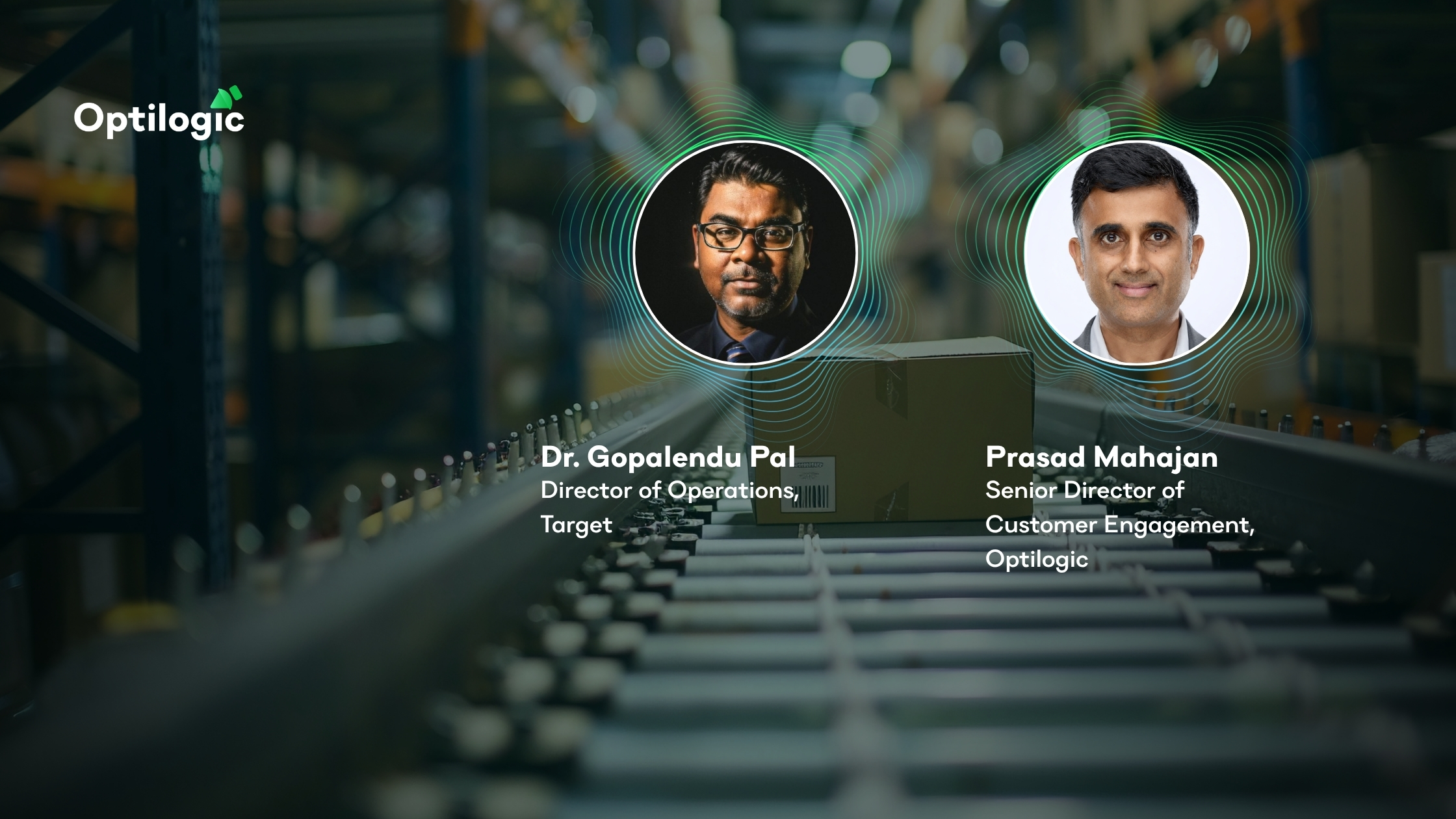



Shared goals, audited assumptions, and scenario planning at scale: how two supply chain leaders think about staying ready for disruption.
A Stanley Tumbler goes viral after a woman walks out of a car crash still holding hers. Within hours, Target's entire inventory of that cup is gone. No forecast saw it coming, because nothing in the historical data could have predicted it.
That story, told by Dr. Gopalendu Pal, Director of Operations at Target, on a recent Emerj "AI in Business" podcast, is a good stand-in for where most companies are right now: running systems built for a normal that keeps changing shape. Tariffs move from 50% to 15% and back. Port strikes hit without warning. A single social post can wipe out a category. Dr. Pal, alongside Optilogic's Prasad Mahajan, spent the episode discussing the benefits of adding more AI compared to fixing the decisions underneath it.
Visit the Emerj website for the full episode.
Most planning systems, Mahajan pointed out, are still optimizing against assumptions nobody has questioned in years: static lead times, fixed supplier mixes, and forecasts built on three or four years of history. That works fine until the environment changes. Then a company is, in his words, "planning in a box that no longer fits your current world."
Dr. Pal backed this up with numbers from a Bain & Company study found more than 15 major volatility events over a single 10-year stretch, including hurricanes, ice storms, COVID, and energy shocks. "We accept volatility is there and will be there," he said. The systems built to forecast a stable world won't survive an unstable one.
Both guests converged on the same root cause underneath the noise: siloed KPIs:
None of those goals are wrong on their own, but nobody is looking at the big picture. As Mahajan put it, the real question is "is my sub-optimization really hurting my overall network?" Most companies don't find out until volatility forces the issue.
Dr. Pal added his perspective with two practical moves:
Auditing decisions before adding technology. Before any AI conversation, Dr. Pal pushes teams to look hard at their existing standard operating procedures, including what's working and what isn't. His metaphor is: AI is "a fantastic hammer, probably the best hammer we've invented so far, but it's still a hammer." Give it to a team that doesn't understand the process it's amplifying, and you get faster, better-resourced versions of bad decisions.
Setting goals at the supply chain level, not the team level. Every function has its own goalpost: procurement, logistics, store operations. Almost none of them have a shared one. He shared an example of a procurement decision to buy inventory at a certain price that only makes sense once you factor in whether logistics can move it efficiently and whether the warehouse can absorb the added cost. "Have a clear goalpost at the network level" was his recommendation; otherwise teams win individually while the business loses collectively.
Mahajan's field experience tells the same story: He described a manufacturing client where quality complaints kept surfacing, but the real problem wasn't capability, it was an expired commercial policy nobody had revisited. "Audit your constraints and business rules," he said, "and have a process which allows people to talk to each other openly." Same diagnosis, different industry.
Once the process and the goals are sound, both guests agreed the highest-value use of AI isn't prediction, but scenario planning at a speed no team could match manually. Mahajan described running "300 or 400 scenarios" against different sensitivity levels to see how a disruption would ripple through a network before it happens, rather than reacting to it after the fact.
Dr. Pal framed the shift in adoption terms: scenario analysis used to require an engineer's specialized skill to run a simulation. Now, conversational AI has lowered that barrier enough that teams across distribution, transportation, and even the store floor can ask direct questions and get a usable answer back with no modeling expertise required.
Mahajan added an important caveat: humans need to stay in the loop to stress-test whether a recommendation is one the business — and its customers — can live with.
Neither guest believes that AI will make volatility predictable. The goal is a supply chain that's designed to keep pace with disruption instead of being caught off-guard by it:
The middle bullet is the one companies skip most often: procurement, logistics, and warehouse operations each hitting their own numbers while the business loses money, because nobody owns the goal that spans all three. Fixing that isn't an AI problem, it's a decision-rights problem. Until someone has the authority to set a goal that overrides procurement's, logistics', and the warehouse's individual numbers, adding AI just makes each team faster at optimizing for the wrong thing.
Shared goals, audited assumptions, and scenario planning at scale: how two supply chain leaders think about staying ready for disruption.
A Stanley Tumbler goes viral after a woman walks out of a car crash still holding hers. Within hours, Target's entire inventory of that cup is gone. No forecast saw it coming, because nothing in the historical data could have predicted it.
That story, told by Dr. Gopalendu Pal, Director of Operations at Target, on a recent Emerj "AI in Business" podcast, is a good stand-in for where most companies are right now: running systems built for a normal that keeps changing shape. Tariffs move from 50% to 15% and back. Port strikes hit without warning. A single social post can wipe out a category. Dr. Pal, alongside Optilogic's Prasad Mahajan, spent the episode discussing the benefits of adding more AI compared to fixing the decisions underneath it.
Visit the Emerj website for the full episode.
Most planning systems, Mahajan pointed out, are still optimizing against assumptions nobody has questioned in years: static lead times, fixed supplier mixes, and forecasts built on three or four years of history. That works fine until the environment changes. Then a company is, in his words, "planning in a box that no longer fits your current world."
Dr. Pal backed this up with numbers from a Bain & Company study found more than 15 major volatility events over a single 10-year stretch, including hurricanes, ice storms, COVID, and energy shocks. "We accept volatility is there and will be there," he said. The systems built to forecast a stable world won't survive an unstable one.
Both guests converged on the same root cause underneath the noise: siloed KPIs:
None of those goals are wrong on their own, but nobody is looking at the big picture. As Mahajan put it, the real question is "is my sub-optimization really hurting my overall network?" Most companies don't find out until volatility forces the issue.
Dr. Pal added his perspective with two practical moves:
Auditing decisions before adding technology. Before any AI conversation, Dr. Pal pushes teams to look hard at their existing standard operating procedures, including what's working and what isn't. His metaphor is: AI is "a fantastic hammer, probably the best hammer we've invented so far, but it's still a hammer." Give it to a team that doesn't understand the process it's amplifying, and you get faster, better-resourced versions of bad decisions.
Setting goals at the supply chain level, not the team level. Every function has its own goalpost: procurement, logistics, store operations. Almost none of them have a shared one. He shared an example of a procurement decision to buy inventory at a certain price that only makes sense once you factor in whether logistics can move it efficiently and whether the warehouse can absorb the added cost. "Have a clear goalpost at the network level" was his recommendation; otherwise teams win individually while the business loses collectively.
Mahajan's field experience tells the same story: He described a manufacturing client where quality complaints kept surfacing, but the real problem wasn't capability, it was an expired commercial policy nobody had revisited. "Audit your constraints and business rules," he said, "and have a process which allows people to talk to each other openly." Same diagnosis, different industry.
Once the process and the goals are sound, both guests agreed the highest-value use of AI isn't prediction, but scenario planning at a speed no team could match manually. Mahajan described running "300 or 400 scenarios" against different sensitivity levels to see how a disruption would ripple through a network before it happens, rather than reacting to it after the fact.
Dr. Pal framed the shift in adoption terms: scenario analysis used to require an engineer's specialized skill to run a simulation. Now, conversational AI has lowered that barrier enough that teams across distribution, transportation, and even the store floor can ask direct questions and get a usable answer back with no modeling expertise required.
Mahajan added an important caveat: humans need to stay in the loop to stress-test whether a recommendation is one the business — and its customers — can live with.
Neither guest believes that AI will make volatility predictable. The goal is a supply chain that's designed to keep pace with disruption instead of being caught off-guard by it:
The middle bullet is the one companies skip most often: procurement, logistics, and warehouse operations each hitting their own numbers while the business loses money, because nobody owns the goal that spans all three. Fixing that isn't an AI problem, it's a decision-rights problem. Until someone has the authority to set a goal that overrides procurement's, logistics', and the warehouse's individual numbers, adding AI just makes each team faster at optimizing for the wrong thing.
Fill out the form to unlock the full content
.jpg)