Published by
Published on
February 25, 2026



Every supply chain leader has had this experience: Your team spends months building a comprehensive network optimization model. You're chasing logistics cost savings—perhaps by targeting a 10-15% reduction in transportation spend. You present the results. Leadership approves. Implementation begins.
Then you discover the real cost savings opportunity wasn't where you were looking at all.
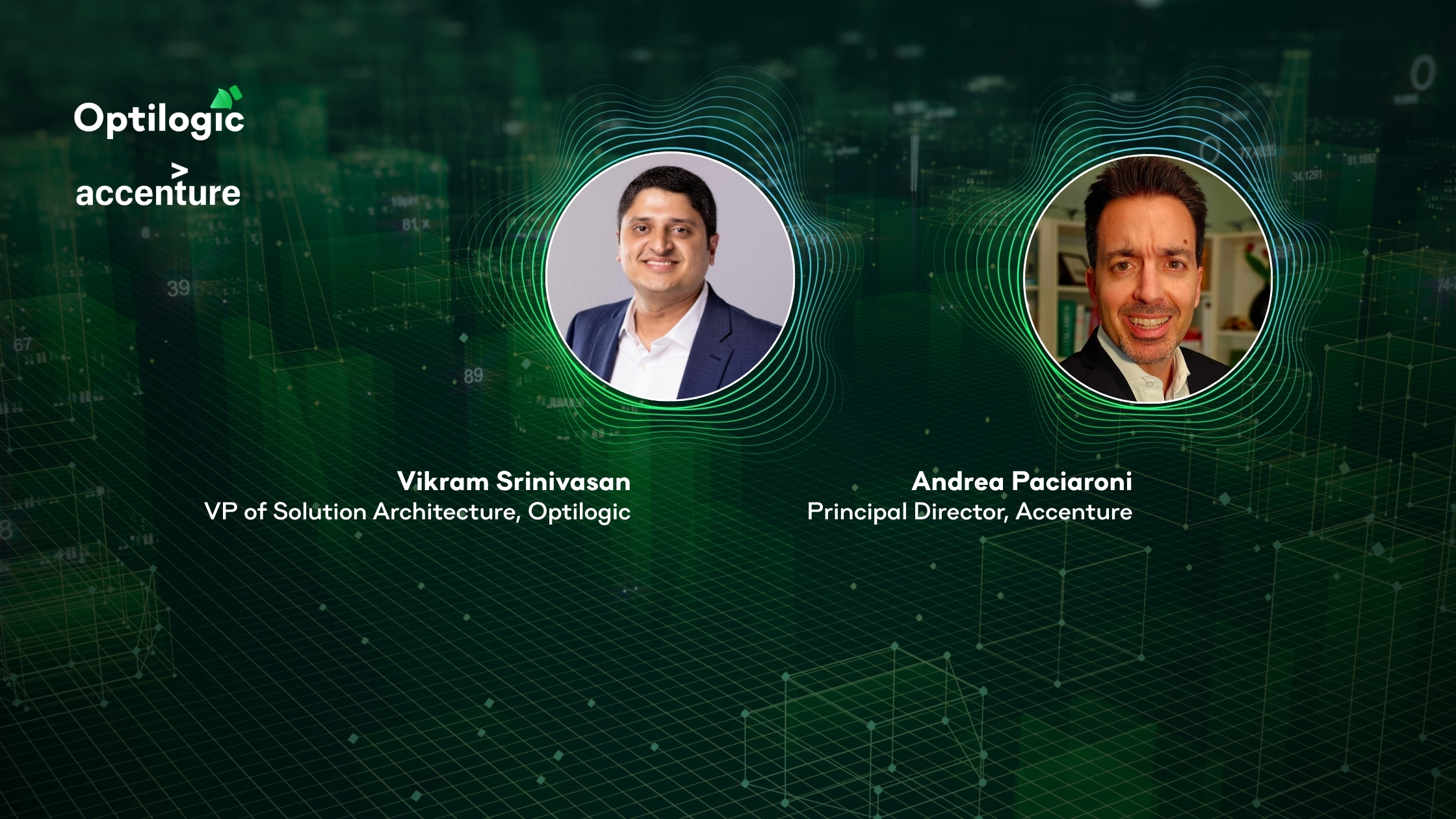
These insights emerged from a recent Let's Talk Supply Chain webinar hosted by founder Sarah Barnes-Humphrey, where Optilogic's Vikram Srinivasan, Vice President of Solution Architecture, joined Andrea Paciaroni, Principal Director at Accenture, to explore how AI is reshaping supply chain decision-making.
Before we get to ROI, we need to address the elephant in the room: your team is drowning in data preparation.
It's a stunning statistic that takes supply chain leaders by surprise: data preparation consumes 80% of the overall time on new projects.
Vikram Srinivasan from Optilogic explains why this matters urgently:
"The problem is executives and teams need answers in the same day or sometimes in the next few days. If we take as long as six weeks to go and do these things to get an answer, then the inputs and the assumptions have already shifted. Now you're likely playing catch-up. And you're never going to catch up."
Your team isn't slow because they lack skill or dedication. They're slow because they're spending 80% of their time wrangling spreadsheets, reconciling data formats, and hunting down missing cost information instead of actually analyzing supply chain strategy.
Andrea Paciaroni from Accenture shares a case study that perfectly illustrates where real ROI hides.
When the U.S. suspended the de minimis exemption, e-commerce and retail companies faced a dramatic change. Many had structured their distribution networks with nodes in Mexico and Canada, and now needed to completely rethink their product flows.
Accenture helped these companies build digital twins—SKU-level, order-level virtual replicas of their entire operations—to model the impact. They brought together cross-functional expertise: legal teams understanding duty structures, supply chain teams analyzing landed costs, and operational teams evaluating network configurations.
They expected to find ROI in logistics cost optimization or duty reduction.
That's not what they found.
Andrea explains what actually emerged from the analysis:
"We found out things that were impossible to really measure in the past such as fill rate. How is fill rate changing if we create different silos? If I stop sharing inventory between Canada and the US, what does it mean from an exposure of products to my customers online? Those typically tend to be very theoretical, very institutional knowledge. We actually simulated through Monte Carlo simulation and actually we demonstrated that the number one problem in all of this was not necessarily logistic cost or some of the duties but the impact on fill rate—actual losing sales."
Read that again. The biggest impact wasn't transportation costs or tariff expenses.
It was lost sales from reduced fill rates.
When you create inventory silos by separating Canada and U.S. operations, you lose the flexibility to share inventory across borders. That theoretical supply chain concept suddenly becomes a very real hit to top-line revenue. Customers can't buy products that aren't available online, regardless of whether you've optimized your logistics costs.
This is ROI that traditional modeling—focused on a single metric like transportation savings—would have completely missed.
Sarah Barnes Humphrey captured the essence of this discovery perfectly:
"ROI doesn't always come from where you think it will... You might think it's going to come from one area, but when you run these simulations, you run these scenarios, and you're able to collaborate internally within different departments, it's really a light bulb moment for everybody."
Andrea builds on this insight:
"In the past we want to start with the metric and says what are the savings in transportation. Now because we run a full company then we observe from the top and say ‘How did it go?’ Did these metrics go up and the other go down? We can look at the whole spectrum of not just one calculation in Excel or one metric."
The difference is fundamental:
Old approach: Pick a metric (transportation cost), build a model optimized for that metric, measure success against that metric.
New approach: Build a comprehensive digital twin, simulate the entire operation, observe what actually happens across all metrics simultaneously.
When you can model at the order level, SKU level, minute by minute—when you can run Monte Carlo simulations that capture real-world variability—you start seeing impacts that traditional optimization completely obscures.
There's another hidden ROI that Andrea identifies cross-functional credibility.
"When you start bringing this capability to the size of the simulation and the granularity you start seeing people that are not in supply chain— maybe they're in finance— and they are saying, ‘Okay so you guys know how to do math in supply chain.’"
When finance sees supply chain teams quantifying fill rate impacts through rigorous simulation instead of relying on "institutional knowledge" and gut feel, the conversation changes. Supply chain moves from cost center to strategic partner.
That credibility enables better collaboration, faster decision-making, and more ambitious supply chain transformation initiatives. It's ROI that never shows up in a business case but fundamentally changes organizational capability.
The reason these comprehensive simulations are now possible is that AI eliminates the data preparation bottleneck.
Vikram explains what AI actually automates:
"The areas we see AI really play a big role is around the upstream raw data cleansing. So quickly identifying the data. For example, when you get a data set, you're looking for 25 to 30 different things... AI will figure all that out for us. It can get us very quickly to a point where it's mapped that data, it's added the context, and it's built a model for you."
When data prep takes hours instead of weeks:
Andrea notes the transformation this enables:
"When we talk about digital twin virtual replication or simulation of a company, half of the executives tend to fall off the chair because they’re assuming ‘Oh this is going to be an enormous project: a multi-year, multi-million dollar one.’ But actually, if we keep getting better on that data preparation... we can cut very short and make these projects just creating this capability way faster and making it more affordable for companies."
Digital twins go from multi-year, multi-million-dollar moonshots to practical three-to-four-month implementations.
Once you've eliminated the data bottleneck, ROI multiplies through three paths:
More Frequent Refresh: When scenario updates take hours instead of weeks, you can find opportunities faster and implement quicker. Teams can respond to market changes, tariff shifts, and demand fluctuations with prepared playbooks instead of scrambling to build models after disruption hits.
Broader Coverage: Comprehensive analysis becomes economically feasible. Cover all business units, all factories, all regions. Do the breadth as well as the depth. The de minimis case study only worked because teams could model the entire operation at granular detail.
New Use Cases: When your team isn't drowning in data prep, they can tackle questions they never had time for before: cost-to-serve analysis, risk quantification, upstream supply optimization, inventory strategy—all the strategic questions that create competitive advantage.
Andrea identifies another often-overlooked benefit: breaking the "single wizard" dependency.
"Data preparation was always contained to ‘the wizard’— the single individual sometimes a few individuals that really know the data and understand and where it is what it means. I think that's a great opportunity now with the AI to be augmented and being able to ask questions... and not having to rely necessarily to the ‘single wizard.’"
When one person controls all the data knowledge, you have a bottleneck and a retention risk. When AI-powered data platforms democratize access through natural language interfaces, more team members can contribute to analysis.
Junior resources get excited. Teams move faster. Supply chain becomes a competitive advantage instead of a perpetual constraint.
The real ROI from eliminating data bottlenecks isn't faster models or lower costs.
It's discovering that your biggest risk was fill rate impact, not logistics costs.
It's finding that inventory siloing loses more revenue than you'd save in duties.
It's building cross-functional credibility that transforms supply chain from cost center to strategic partner.
It's moving from three scenarios to three hundred, from aggregate flows to order-level precision, from annual planning exercises to continuous design capabilities.
Your team already knows how to find ROI. They just need time to actually look for it.
When you stop spending 80% of time on data wrangling, you finally get to spend 80% of time on strategic thinking. That's when you discover where the real ROI has been hiding all along.
Ready to discover your hidden ROI? Learn how Cosmic Frog and DataStar eliminate data bottlenecks so your team can focus on finding value instead of formatting spreadsheets. Explore supply chain design solutions →
Every supply chain leader has had this experience: Your team spends months building a comprehensive network optimization model. You're chasing logistics cost savings—perhaps by targeting a 10-15% reduction in transportation spend. You present the results. Leadership approves. Implementation begins.
Then you discover the real cost savings opportunity wasn't where you were looking at all.
These insights emerged from a recent Let's Talk Supply Chain webinar hosted by founder Sarah Barnes-Humphrey, where Optilogic's Vikram Srinivasan, Vice President of Solution Architecture, joined Andrea Paciaroni, Principal Director at Accenture, to explore how AI is reshaping supply chain decision-making.
Before we get to ROI, we need to address the elephant in the room: your team is drowning in data preparation.
It's a stunning statistic that takes supply chain leaders by surprise: data preparation consumes 80% of the overall time on new projects.
Vikram Srinivasan from Optilogic explains why this matters urgently:
"The problem is executives and teams need answers in the same day or sometimes in the next few days. If we take as long as six weeks to go and do these things to get an answer, then the inputs and the assumptions have already shifted. Now you're likely playing catch-up. And you're never going to catch up."
Your team isn't slow because they lack skill or dedication. They're slow because they're spending 80% of their time wrangling spreadsheets, reconciling data formats, and hunting down missing cost information instead of actually analyzing supply chain strategy.
Andrea Paciaroni from Accenture shares a case study that perfectly illustrates where real ROI hides.
When the U.S. suspended the de minimis exemption, e-commerce and retail companies faced a dramatic change. Many had structured their distribution networks with nodes in Mexico and Canada, and now needed to completely rethink their product flows.
Accenture helped these companies build digital twins—SKU-level, order-level virtual replicas of their entire operations—to model the impact. They brought together cross-functional expertise: legal teams understanding duty structures, supply chain teams analyzing landed costs, and operational teams evaluating network configurations.
They expected to find ROI in logistics cost optimization or duty reduction.
That's not what they found.
Andrea explains what actually emerged from the analysis:
"We found out things that were impossible to really measure in the past such as fill rate. How is fill rate changing if we create different silos? If I stop sharing inventory between Canada and the US, what does it mean from an exposure of products to my customers online? Those typically tend to be very theoretical, very institutional knowledge. We actually simulated through Monte Carlo simulation and actually we demonstrated that the number one problem in all of this was not necessarily logistic cost or some of the duties but the impact on fill rate—actual losing sales."
Read that again. The biggest impact wasn't transportation costs or tariff expenses.
It was lost sales from reduced fill rates.
When you create inventory silos by separating Canada and U.S. operations, you lose the flexibility to share inventory across borders. That theoretical supply chain concept suddenly becomes a very real hit to top-line revenue. Customers can't buy products that aren't available online, regardless of whether you've optimized your logistics costs.
This is ROI that traditional modeling—focused on a single metric like transportation savings—would have completely missed.
Sarah Barnes Humphrey captured the essence of this discovery perfectly:
"ROI doesn't always come from where you think it will... You might think it's going to come from one area, but when you run these simulations, you run these scenarios, and you're able to collaborate internally within different departments, it's really a light bulb moment for everybody."
Andrea builds on this insight:
"In the past we want to start with the metric and says what are the savings in transportation. Now because we run a full company then we observe from the top and say ‘How did it go?’ Did these metrics go up and the other go down? We can look at the whole spectrum of not just one calculation in Excel or one metric."
The difference is fundamental:
Old approach: Pick a metric (transportation cost), build a model optimized for that metric, measure success against that metric.
New approach: Build a comprehensive digital twin, simulate the entire operation, observe what actually happens across all metrics simultaneously.
When you can model at the order level, SKU level, minute by minute—when you can run Monte Carlo simulations that capture real-world variability—you start seeing impacts that traditional optimization completely obscures.
There's another hidden ROI that Andrea identifies cross-functional credibility.
"When you start bringing this capability to the size of the simulation and the granularity you start seeing people that are not in supply chain— maybe they're in finance— and they are saying, ‘Okay so you guys know how to do math in supply chain.’"
When finance sees supply chain teams quantifying fill rate impacts through rigorous simulation instead of relying on "institutional knowledge" and gut feel, the conversation changes. Supply chain moves from cost center to strategic partner.
That credibility enables better collaboration, faster decision-making, and more ambitious supply chain transformation initiatives. It's ROI that never shows up in a business case but fundamentally changes organizational capability.
The reason these comprehensive simulations are now possible is that AI eliminates the data preparation bottleneck.
Vikram explains what AI actually automates:
"The areas we see AI really play a big role is around the upstream raw data cleansing. So quickly identifying the data. For example, when you get a data set, you're looking for 25 to 30 different things... AI will figure all that out for us. It can get us very quickly to a point where it's mapped that data, it's added the context, and it's built a model for you."
When data prep takes hours instead of weeks:
Andrea notes the transformation this enables:
"When we talk about digital twin virtual replication or simulation of a company, half of the executives tend to fall off the chair because they’re assuming ‘Oh this is going to be an enormous project: a multi-year, multi-million dollar one.’ But actually, if we keep getting better on that data preparation... we can cut very short and make these projects just creating this capability way faster and making it more affordable for companies."
Digital twins go from multi-year, multi-million-dollar moonshots to practical three-to-four-month implementations.
Once you've eliminated the data bottleneck, ROI multiplies through three paths:
More Frequent Refresh: When scenario updates take hours instead of weeks, you can find opportunities faster and implement quicker. Teams can respond to market changes, tariff shifts, and demand fluctuations with prepared playbooks instead of scrambling to build models after disruption hits.
Broader Coverage: Comprehensive analysis becomes economically feasible. Cover all business units, all factories, all regions. Do the breadth as well as the depth. The de minimis case study only worked because teams could model the entire operation at granular detail.
New Use Cases: When your team isn't drowning in data prep, they can tackle questions they never had time for before: cost-to-serve analysis, risk quantification, upstream supply optimization, inventory strategy—all the strategic questions that create competitive advantage.
Andrea identifies another often-overlooked benefit: breaking the "single wizard" dependency.
"Data preparation was always contained to ‘the wizard’— the single individual sometimes a few individuals that really know the data and understand and where it is what it means. I think that's a great opportunity now with the AI to be augmented and being able to ask questions... and not having to rely necessarily to the ‘single wizard.’"
When one person controls all the data knowledge, you have a bottleneck and a retention risk. When AI-powered data platforms democratize access through natural language interfaces, more team members can contribute to analysis.
Junior resources get excited. Teams move faster. Supply chain becomes a competitive advantage instead of a perpetual constraint.
The real ROI from eliminating data bottlenecks isn't faster models or lower costs.
It's discovering that your biggest risk was fill rate impact, not logistics costs.
It's finding that inventory siloing loses more revenue than you'd save in duties.
It's building cross-functional credibility that transforms supply chain from cost center to strategic partner.
It's moving from three scenarios to three hundred, from aggregate flows to order-level precision, from annual planning exercises to continuous design capabilities.
Your team already knows how to find ROI. They just need time to actually look for it.
When you stop spending 80% of time on data wrangling, you finally get to spend 80% of time on strategic thinking. That's when you discover where the real ROI has been hiding all along.
Ready to discover your hidden ROI? Learn how Cosmic Frog and DataStar eliminate data bottlenecks so your team can focus on finding value instead of formatting spreadsheets. Explore supply chain design solutions →
Fill out the form to unlock the full content
.jpg)